

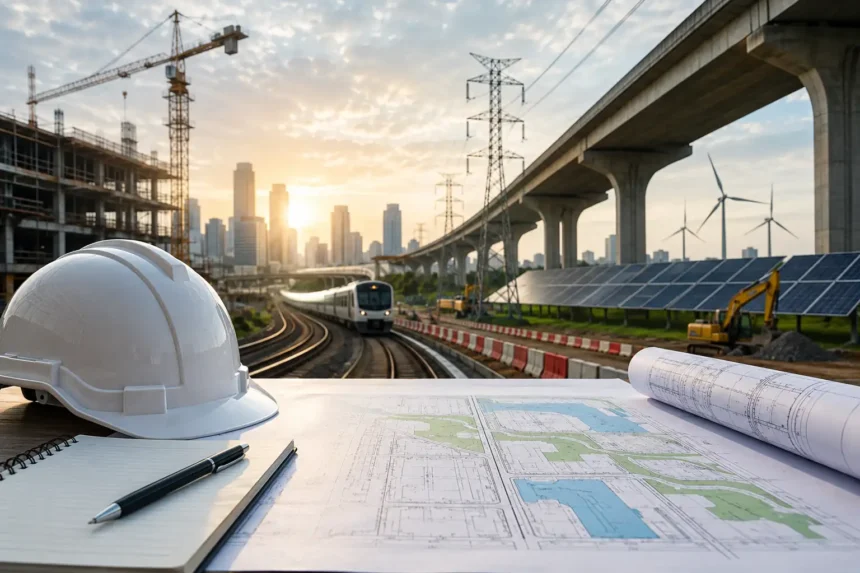
A priority infrastructure plan is a structured framework that governments and organizations use to decide which infrastructure projects to fund first, and in what order. It exists because no budget is unlimited — roads deteriorate, water systems age, and demand for services grows faster than the money available to address it. Rather than reacting to crises one at a time, a well-built plan creates a rational, defensible system for directing capital where it matters most.
- What Is a Priority Infrastructure Plan (PIP)?
- Why Most Infrastructure Plans Fail
- Core Pillars of a Successful Priority Infrastructure Plan
- Key Criteria Used to Prioritize Infrastructure Projects
- How to Create a Priority Infrastructure Plan Step by Step
- Step 1 – Baseline Asset Assessment
- Step 2 – Defining Strategic Objectives
- Step 3 – Developing the Prioritization Matrix
- Step 4 – Stakeholder Engagement and Public Buy-in
- Step 5 – Funding and Financial Modeling
- Step 6 – Drafting the Implementation Roadmap
- Step 7 – Monitoring, Evaluation, and Agile Adaptation
- Scoring Frameworks and Prioritization Models
- Priority Infrastructure Areas (PIAs) and Urban Growth Planning
- Global Examples of Priority Infrastructure Plan Implementation
- The Role of Infrastructure Planning in Economic Growth
- Challenges and Limitations in Implementation
- The Role of Modern Technology in Infrastructure Planning
- How City Size Affects Infrastructure Prioritization
- Common Pitfalls and How to Avoid Them
- Conclusion
- FAQs
- What is a Priority Infrastructure Plan, and how does it work?
- How do you identify Priority Infrastructure Areas (PIAs)?
- What is the Infrastructure Prioritization Framework (IPF)?
- How does the WSJF model work for infrastructure prioritization?
- Why do most infrastructure plans fail?
- How does a PIP differ from a Capital Improvement Plan (CIP)?
- How can small municipalities with limited budgets create a PIP?
This guide covers everything from foundational concepts to step-by-step creation, scoring models, global examples, and the most common mistakes that cause plans to fail.
What Is a Priority Infrastructure Plan (PIP)?
A Priority Infrastructure Plan is an evidence-based planning document that identifies critically needed public works projects, ranks them by importance, and sequences their delivery over a defined period — typically 5 to 20 years.
It differs from a general master plan, which tends to be a wish list without financial grounding. A PIP answers three specific questions:
- What does the community need most urgently?
- How will it be paid for?
- When will construction realistically happen?
Coverage spans a wide range of assets — from upgrading a wastewater treatment facility or expanding a mass transit line to deploying municipal fiber-optic internet. The goal is to ensure capital allocation serves public safety, economic vitality, and quality of life in that order of priority.
Why Most Infrastructure Plans Fail
The majority of infrastructure planning documents never translate into completed projects. Understanding why is just as important as knowing how to build a plan correctly.
The most common failure patterns include:
- Squeaky Wheel Syndrome — Projects get funded based on who complains loudest, not what data supports. Political pressure overrides objective ranking.
- The Funding Gap — A plan may list $500 million in projects while the municipality’s borrowing capacity sits at $50 million. Without a logical path to close that gap, the document is fiction.
- No Public Agreement — When communities are excluded from the planning process, NIMBY (Not In My Backyard) resistance, lawsuits, and delays become inevitable.
- Static Thinking — Plans that treat the world as fixed collapse the moment a pandemic hits, a major employer leaves, or a federal grant program changes.
Poor project performance costs organizations an average of 11.4% of their total investment, according to the Project Management Institute. Just 56% of strategic initiatives successfully achieve their intended objectives. A priority infrastructure plan, built correctly, directly addresses both problems.
Core Pillars of a Successful Priority Infrastructure Plan
Four foundations determine whether a plan survives budget cycles, political turnover, and unforeseen disruption.
Data-Driven Objectivity — Decisions must rest on dry metrics: traffic counts, pipe deterioration rates, population-growth projections, and economic impact modeling. When a plan is grounded in data, it becomes harder to override for political convenience.
Economic Reality — A PIP is fundamentally a financial document. It requires a clear understanding of municipal bonding capacity, federal and state grant availability, and the realistic scope of Public-Private Partnerships (PPP).
Equity and Inclusion — Infrastructure has historically bypassed underserved communities. Modern plans — and increasingly, federal grant requirements — demand evidence that upgrades reach historically neglected neighborhoods. This is both a moral obligation and a practical prerequisite for funding eligibility.
Resilience and Sustainability — Projects must be evaluated on carbon cost, flood protection capacity, resilience to heatwaves, and climate shocks. Infrastructure governance frameworks that skip this step build assets that become liabilities within a decade.
Key Criteria Used to Prioritize Infrastructure Projects
Different regions apply different models, but these criteria consistently appear in high-performing plans:
| Criterion | What It Measures |
| Urgency / Safety Risk | Imminent failure risk, deteriorating bridge, structural deficiency |
| Economic Impact | Jobs, freight mobility, trade routes, and industrial productivity |
| Social Necessity | Access to clean water, healthcare facilities, schools, and emergency services |
| Environmental Resilience | Flood hazards, drainage infrastructure, energy efficiency, and climate-related impacts |
| Feasibility & Readiness | Land acquisition status, design approvals, and funding arrangements |
Projects that score well across multiple criteria move to the front of the queue. Projects with consistently low rankings are often postponed or revised before resources are allocated.
How to Create a Priority Infrastructure Plan Step by Step
Step 1 – Baseline Asset Assessment
Before ranking projects, planners need a full picture of what already exists and how close it is to failure. This starts with a complete asset inventory covering roads, bridges, water mains, public buildings, and transit vehicles.
Each asset gets graded on a scale of A through F — ideally by third-party engineering firms to ensure impartial grading. The key metric here is Remaining Useful Life (RUL): how many years before an asset reaches total failure. Geographic Information Systems (GIS) are used to map this data spatially. When a neighborhood shows a cluster of F-rated water mains, the case for prioritization becomes visually immediate.
Step 2 – Defining Strategic Objectives
A PIP without clear objectives drifts. Strategic goals must connect directly to a region’s Comprehensive Plan, Climate Action Plan, and Economic Development Strategy.
Objectives must be SMART — Specific, Measurable, Achievable, Relevant, and Time-Bound. “Improve roads” fails this test. “Reduce potholes on all arterial roads by 40% within three years to support freight movement” passes it. The difference matters when defending budget decisions to a city council or state agency.
Step 3 – Developing the Prioritization Matrix
This is where the plan separates from guesswork. A scoring matrix assigns weights to 5 to 7 key criteria based on the region’s strategic priorities. A common structure looks like this:
| Criterion | Weight |
| Public Health & Safety | 25% |
| Economic Development | 20% |
| Regulatory Compliance (EPA, wastewater mandates) | 15% |
| Sustainability & Resilience | 15% |
| Social Equity | 15% |
| Cost & Funding Readiness | 10% |
Each project gets scored across every criterion. The total score determines placement in the build sequence. This structure makes it nearly impossible to justify funding a low-priority vanity project over a critical public safety repair.
Step 4 – Stakeholder Engagement and Public Buy-in
A plan without community support stalls. From the earliest stages, the public needs to be part of the process — not just informed of decisions already made.
Effective engagement tools include interactive town halls where attendees allocate a fixed “budget” among competing infrastructure types, digital surveys that capture input from residents who can’t attend evening meetings, and direct outreach to the business community through Chambers of Commerce. Transparency throughout the process reduces NIMBY resistance and builds the political trust needed for long-term execution.
Step 5 – Funding and Financial Modeling
Strong plans tie specific projects to specific funding sources. Key streams include:
- Pay-As-You-Go (Cash) — Smaller, recurring projects funded through current tax revenues
- Municipal Bonds — Capital expenditure loans repaid over 20–30 years
- Federal and State Grants — Highly competitive; high-scoring matrix projects are best positioned to win
- Public-Private Partnerships (PPPs) — Private companies finance, build, or operate assets like toll roads or broadband networks
- Value Capture — Tax increment financing near new transit lines, where rising property values fund the transit project itself
Step 6 – Drafting the Implementation Roadmap
Once priorities are set and funding is mapped, the sequencing work begins. Dig once policies save high costs — if Main Street is being excavated for a sewer line, scheduling broadband fiber installation and road repaving simultaneously avoids a second round of disruption and millions in duplicate costs.
A Gantt Chart covering years 1–5 outlines planning, design, procurement, and construction timelines for each project. Each project should have a named department and project manager accountable for delivery.
Step 7 – Monitoring, Evaluation, and Agile Adaptation
A priority infrastructure plan is a living document, not a one-time publication. Annual reviews — timed to the budget cycle — assess whether projects are on track, on budget, and still correctly ranked given new data.
Key performance indicators (KPIs) track delivery against timelines. When a grant falls through, the next shovel-ready project on the ranked list moves up. Contingency reserves protect against inflation — a $10 million project today can easily reach $14 million within three years due to labor supply chain pressures and material costs.
Scoring Frameworks and Prioritization Models
Infrastructure Prioritization Framework (IPF)
The World Bank developed the IPF and piloted it in Vietnam and Panama. It evaluates projects using two distinct indices plotted on a Cartesian plane:
- Social-Environmental Index (SEI) — Measures community impact, equity, and environmental outcomes
- Financial-Economic Index (FEI) — Measures economic return and financial viability
Overlaying the budget constraint on this grid creates four quadrants. Quadrant A (high SEI, high FEI) projects get funded immediately. Quadrant D (low on both) projects get rejected or redesigned.
Weighted Shortest Job First (WSJF)
Borrowed from Agile methodologies, WSJF calculates: (Business Value + Time Criticality + Risk Reduction) ÷ Job Size. Projects that deliver high value quickly and require less effort score highest and move to the top of the priority infrastructure plan. This model strengthens infrastructure lifecycle management by preventing large, low-return projects from crowding out faster, high-impact work.
Priority Infrastructure Areas (PIAs) and Urban Growth Planning
Priority Infrastructure Areas (PIAs) define specific geographic zones where growth is expected, and trunk infrastructure — water, sewer, transport, and parks — will be provided to support it. Queensland, Australia, uses PIAs mapped on a cadastral ground, aligning boundaries with actual property lines for legal and planning clarity.
A PIA typically covers 10 to 15 years of anticipated growth. It does not have to be a single continuous zone — non-contiguous areas and rural residential land can be included when a focus plan exists to service them. This approach directly prevents urban sprawl by concentrating infrastructure delivery where density justifies the investment.
Global Examples of Priority Infrastructure Plan Implementation
United Kingdom
The UK merged the National Infrastructure Commission (NIC) and the Infrastructure and Projects Authority (IPA) into the National Infrastructure and Service Transformation Authority (NISTA) in 2025. This consolidation was designed to close the gap between planning and delivery — a persistent problem in large-scale municipal infrastructure planning.
Japan
Japan operates on a structured five-year cycle. The 5th Priority Plan for Infrastructure Development (FY2021–FY2025) focuses on four key areas: strengthening national resilience through disaster prevention and mitigation, maintaining and renewing aging infrastructure with effective asset management, and advancing digital Transformation (DX) to improve construction safety, and Regional Revitalization to support local economies through targeted life-support services.
The Role of Infrastructure Planning in Economic Growth
Well-timed infrastructure investment triggers compounding returns. When transportation routes improve, logistics costs drop. When utilities become reliable, businesses expand. Private investment follows essential infrastructure — housing developers, manufacturers, and commercial operators all make location decisions based on infrastructure availability.
The global infrastructure funding gap stands at an estimated $15 trillion by 2040. Regions that build effective planning frameworks capture a disproportionate share of available federal grants and private capital, while regions without structured plans watch investment pass them by. Industrial zones without strong transport links and power supply consistently underperform or fail outright.
Challenges and Limitations in Implementation
Even well-constructed plans face real obstacles:
- Uncertainty — Long-term forecasting is never precise. Population growth, economic conditions, and political priorities shift.
- Funding Constraints — Consistent financial resources over 10–20 year periods are difficult to maintain across election cycles.
- Coordination Failures — Multiple agencies with competing objectives and timelines require strong governance to align.
- Community Resistance — Land acquisition triggers legal disputes. Environmental concerns delay approvals. Public expectations for visible, short-term projects often conflict with long-term essential infrastructure needs.
- Inflation Underestimation — Projects planned without contingency reserves regularly face cost overruns. Catastrophic failures — sinkholes, bridge closures — force sudden fund reallocation that disrupts carefully sequenced timelines.
The Role of Modern Technology in Infrastructure Planning
Digital tools are changing how plans are built and maintained. Digital Twins — virtual replicas of a city’s infrastructure — allow planners to simulate the effect of closing a bridge or adding a transit line before committing a dollar to construction.
Predictive Analytics and AI analyze decades of repair data to forecast when a water main is likely to rupture, enabling proactive replacement rather than emergency response. IoT Sensors embedded in bridges and roads monitor structural health in real time, feeding continuous data back into the baseline assessment and keeping the priority ranking current between formal reviews.
These tools shift infrastructure planning from periodic snapshots to a continuously adaptive system — one that responds to actual conditions rather than assumptions made years earlier.
How City Size Affects Infrastructure Prioritization
An NLC survey of 178 municipal finance officials reveals a clear pattern: large cities prioritize infrastructure more consistently than smaller ones — not because the needs differ, but because the capacity to act does.
| Infrastructure Type | % Ranking as High Priority |
| Streets & Roads | 88% |
| Water Systems | 85% |
| Sewer / Storm Water Drainage | 74% |
Larger cities (population over 300,000) ranked all 11 infrastructure categories as high priority at higher rates than small and mid-sized cities. The reason is straightforward: larger cities have more tax revenue, more staff to write competitive grant applications, and more data available to meet federal match requirements.
Smaller communities under 150,000 in population can access the Local Infrastructure Hub Bootcamp, which helps municipalities build stronger applications for the Infrastructure Investment & Jobs Act (IIJA) funding — directly addressing the technical capacity gap that keeps smaller cities from competing for federal dollars.
Common Pitfalls and How to Avoid Them
Three mistakes consistently derail otherwise sound plans:
Neglecting Maintenance — Politicians cut ribbons on new buildings. Nobody cuts a ribbon on an HVAC replacement. Plans that prioritize new construction over existing asset maintenance create a backlog of catastrophic failures.
Underestimating Inflation — Infrastructure projects have long lead times. Build inflation assumptions and contingency reserves directly into financial models from the start.
Over-Promising on Timelines — When a project promised in two years takes five, public trust erodes, and future projects face harder opposition. Under-promise on timelines and over-deliver on execution.
Conclusion
A priority infrastructure plan turns competing demands, limited budgets, and long timelines into a manageable, defensible sequence. It replaces political favoritism with data, replaces reactive spending with structured forecasting, and replaces fragmented development with phased execution tied to real funding.
The communities that build strong plans — rooted in asset assessment, scored through objective frameworks, aligned with realistic funding sources — consistently outperform those that don’t. Infrastructure is not just construction. It is the foundation on which economic progress, public safety, and quality of life are built. A well-designed plan ensures that the foundation is laid in the right order.
FAQs
What is a Priority Infrastructure Plan, and how does it work?
A Priority Infrastructure Plan is a strategic document that identifies and sequences critically needed public works projects over a defined timeframe — typically 5 to 20 years. It works by scoring projects against clear criteria, mapping them to specific funding sources, and scheduling delivery in phases aligned with community demand and capital availability.
How do you identify Priority Infrastructure Areas (PIAs)?
Priority Infrastructure Areas are mapped on a cadastral basis, aligning zone boundaries with actual property lines. Planners identify locations where trunk infrastructure — water, sewer, and transport — can be efficiently extended to accommodate projected urban growth over 10 to 15 years. Non-contiguous zones can be included when a servicing plan exists.
What is the Infrastructure Prioritization Framework (IPF)?
The IPF was developed by the World Bank and piloted in Vietnam and Panama. It scores projects using a Social-Environmental Index (SEI) and a Financial-Economic Index (FEI), then plots them on a matrix. Projects landing in Quadrant A — high on both indices — receive immediate funding priority.
How does the WSJF model work for infrastructure prioritization?
The Weighted Shortest Job First model scores projects by dividing the combined value of business value, time criticality, and risk reduction by job size. Projects with the highest WSJF score get scheduled first because they deliver the most value in the least time with the least effort.
Why do most infrastructure plans fail?
Most plans fail due to poor resource management, lack of strategic alignment, and political interference. The Squeaky Wheel Syndrome, unrealistic funding assumptions, NIMBY opposition, and static thinking — failing to account for changing conditions — are the most common causes of plans being shelved or ignored.
How often should a Priority Infrastructure Plan be updated?
A PIP functions as a living document. Minor updates should occur annually in sync with the municipal budget cycle. Full revisions are recommended every 3 to 5 years to reflect demographic changes, completed projects, new economic realities, and shifts in available funding programs.
How does a PIP differ from a Capital Improvement Plan (CIP)?
A Priority Infrastructure Plan is the strategic precursor to a Capital Improvement Plan. The PIP determines what needs to happen and in what order — the strategy and ranking. The CIP is the budget document that authorizes actual spending for the first several years of that ranked sequence.
How can small municipalities with limited budgets create a PIP?
Small municipalities do not need expensive consultants to build a functional plan. Excel-based scoring matrices work well for basic prioritization. Local planning commissions offer free mapping and technical assistance. Federal grants — including IIJA funding accessible through the Local Infrastructure Hub — are specifically designed to build technical capacity in smaller communities.