

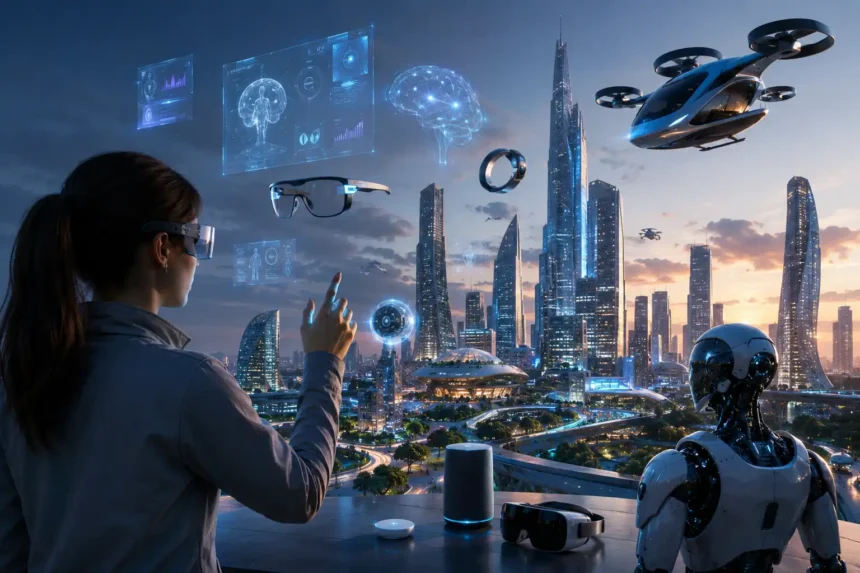
Tech giants envision future beyond smartphones not as a distant concept, but as an active investment happening right now. Apple, Google, Meta, Samsung, and Microsoft are redirecting billions toward AI-powered wearables, AR glasses, mixed-reality headsets, and ambient computing systems. The smartphone is not dying tomorrow, but its role as the central device in our digital lives is already being challenged.
- Why Tech Giants Envision a Future Beyond Smartphones
- Slowing Smartphone Innovation and Market Saturation
- New Platforms, New Power: The Business Case
- AI Demands More Than a Phone Can Offer
- Key Technologies Set to Replace Smartphones
- Augmented Reality (AR) Glasses
- Mixed-Reality Headsets and Spatial Computing
- AI Assistants and Intent-Based Computing
- Wearable Technology
- Ambient and Invisible Computing
- Holographic Displays and Projection Tech
- Which Tech Giants Are Leading the Post-Smartphone Race
- Timeline: When Will Smartphones Be Replaced?
- How Smartphone Innovation Reached a Plateau
- Business Pressures Forcing Tech Giants Beyond Smartphones
- Hardware Margins Under Pressure
- Ads, Services, and Attention Surfaces
- Platform Control as Strategic Priority
- Privacy, Regulation, and Trust: The Biggest Roadblocks
- Will Consumers Accept a World Beyond Smartphones?
- What Consumers Actually Want vs. What’s Being Built
- The Role of Public Spaces and Social Norms
- Lessons From Past Tech Failures
- Tech Giants Envision Future Beyond Smartphones: Conclusion
- FAQs
- Why are major tech companies looking beyond the future of smartphones?
- What technology will replace smartphones in the future?
- Are smartphones going to disappear completely?
- How soon will AR glasses replace smartphones?
- What is ambient computing?
- Which brands are driving the move beyond traditional smartphones?
- How will AI change personal devices in the future?
- How will the future beyond smartphones affect daily life?
Why Tech Giants Envision a Future Beyond Smartphones
Slowing Smartphone Innovation and Market Saturation
The smartphone market has matured. Replacement cycles have stretched to five years or longer in many regions. Mid-range phones now handle most daily tasks just as well as flagship devices, reducing the pressure to upgrade. Refurb markets are growing, installment plans train buyers to hold longer, and software support has extended device lifespans significantly.
Hardware profit pools are shrinking as a result. Modest gains in market penetration mean companies can no longer count on new buyers — only replacements. That reality forces tech companies to look elsewhere for growth.
New Platforms, New Power: The Business Case
A new device category does more than sell hardware. It resets app stores, ad slots, default assistants, and payment rails. Whoever controls the next interface controls where user attention goes — and attention drives revenue.
Platform control is strategic. Apple, Google, and Meta all understand that owning the default search, assistant, or payment layer on a new device is worth far more than the hardware margin. Regulators are already scrutinizing store fees and antitrust concerns on phones. A fresh platform gives these companies a chance to rebuild those margins before oversight catches up.
The roadmap for each of these companies is not just about products — it is about ecosystem lock-in and long-term valuation.
AI Demands More Than a Phone Can Offer
Modern AI works best with constant context. A phone is not always in hand, which limits how much signal it can capture throughout the day. Glasses, earbuds, rings, and watches collect data continuously, then feed results back to the phone or act independently.
This shift moves computing toward intent-based computing — where the device understands what a user needs before they ask. Voice commands, gesture control, and ambient intelligence reduce the friction of opening apps and typing queries. AI features become genuinely useful when the hardware never leaves the user’s body.
Key Technologies Set to Replace Smartphones
Augmented Reality (AR) Glasses
AR glasses overlay digital information onto the real world without requiring a screen in hand. They can deliver navigation cues, notifications, and real-time translations while keeping their hands free.
Apple’s Vision Pro ecosystem is pointing toward lightweight AR glasses as the next step. Meta’s Ray-Ban Meta smart glasses have already sold millions, proving consumer demand exists even at an early stage. Google Project Iris is reviving the company’s AR ambitions, and Samsung is building toward its own XR platform in partnership with Google.
Analysts estimate AR glasses could start taking over core smartphone functions within 10–15 years, once devices become consumer-ready, lightweight, and affordable.
Mixed-Reality Headsets and Spatial Computing
Apple calls it spatial computing. Meta calls it the metaverse. The underlying idea is the same — digital content lives around the user, not inside a screen.
Vision Pro opened the door to virtual workspaces, 3D entertainment, and remote collaboration. Despite mixed reviews, it has taught developers new UI patterns that will shape the next generation of interfaces. Current challenges include device weight, battery limitations, and the isolated feeling often associated with wearing a headset. These are engineering problems with known solutions, not dead ends.
Healthcare, education, and business stand to gain the most from immersive spatial computing as the technology matures.
AI Assistants and Intent-Based Computing
The next computing layer will not be apps — it will be assistants. AI assistants are replacing the need to open, navigate, and manage applications manually.
Personalized recommendations, predictive automation, gesture-based controls, and real-time translation are all moving from experimental to functional. On-device AI processing keeps data local, reducing cloud dependency and improving privacy. Virtual screens projected into space mean users can interact with content without a physical display.
Wearable Technology
Smartwatches, smart rings, and AI-powered earbuds are the closest devices to mainstream adoption today. They already handle real-time health data, tap-to-pay, and passive tracking through sleep and workouts.
Sensor accuracy varies by fit and skin tone, and medical-grade claims face regulatory scrutiny. But the direction is clear — wearables are expanding what a “device” means, moving from something you hold to something you wear.
Ambient and Invisible Computing
Ambient computing removes the interface entirely. Smart homes, smart cars, and connected workplaces run in the background, responding to context rather than commands.
A smart room that adjusts lighting and temperature based on activity, or an AI that schedules a task before the user thinks to ask — these are real near-term applications. The device becomes the environment. Users stop interacting with technology and start living inside it.
Holographic Displays and Projection Tech
Holographic displays represent a longer-term bet. Light-field projectors and skin-based projection interfaces could eventually replace smartphone screens by projecting content directly into space — onto a desk, a wall, or even a hand.
The technology is not consumer-ready yet, but several companies are actively researching 3D holographic systems that would eliminate the need to carry a glass rectangle at all.
Which Tech Giants Are Leading the Post-Smartphone Race
| Company | Primary Bet | Current Stage |
| Apple | Vision Pro → AR glasses, spatial computing | Commercial product launched |
| Gemini AI, smart glasses, ambient computing | Active development | |
| Meta | Ray-Ban smart glasses, metaverse, virtual environments | Millions of units sold |
| Samsung | XR devices, AI-driven mobile experiences | Partnership with Google underway |
| Microsoft | Holographic enterprise solutions | Enterprise focus, ongoing |
Each company is fighting for the same thing: to own the interface that billions of people use daily. The global scale of this shift — involving hundreds of millions of users worldwide — explains why investment continues even when short-term consumer demand stays soft.
Timeline: When Will Smartphones Be Replaced?
No single switch-off date exists. The transition is gradual and will play out across three phases:
- 2025–2030: Early adoption of AR and AI devices alongside smartphones. Wearables expand phone functions but don’t replace them.
- 2030–2035: Widespread adoption of post-smartphone technologies. AR glasses and AI assistants handle a growing share of daily tasks.
- Beyond 2035: Smartphones become secondary devices — still used for setup, typing, and heavy tasks, but no longer the default screen.
The smartphone will follow the same path as the feature phone. It didn’t disappear — it just became less central. The same shift is already starting with wearables taking over minutes of daily use, bit by bit.
How Smartphone Innovation Reached a Plateau
Chips got faster. Screens improved. Cameras added more megapixels. But for the average user who scrolls, messages, and watches videos, none of these gains feel dramatic anymore.
Battery life improved,d but heavy apps kept pace with consumption. Foldables exist, but remain niche and expensive. Compression on social apps hides the difference between a mid-range and a flagship camera. Older phones now receive long software updates and security patches, making cloud backups and device transfers smooth enough that people simply wait longer before replacing them.
Buyers stopped upgrading for performance. They upgrade now when a battery fails or a screen cracks. That behavioral shift is the clearest sign the smartphone has entered the plateau phase.
Business Pressures Forcing Tech Giants Beyond Smartphones
Hardware Margins Under Pressure
Discounts are rising across the smartphone market. Trade-in programs help move units but train consumers to delay purchases. Refurb markets compete directly with new sales. Carriers push long installment plans that extend how long people keep devices, and premium pricing resistance has grown as mid-range hardware has improved.
Margin pressure is real, and bundling wearables with phone plans is one way retailers and carriers are trying to offset it.
Ads, Services, and Attention Surfaces
Ad revenue and subscription growth depend on user attention. If attention shifts to voice assistants and ambient interfaces, companies need to own those surfaces. A wearable ping or a glance at AR glasses can drive daily engagement more effectively than a buried app notification.
Subscriptions need daily touchpoints to maintain retention. New hardware surfaces create those touchpoints outside the phone screen.
Platform Control as Strategic Priority
Default search, payment rails, and assistant placement are worth more than hardware profits. Whoever controls the defaults on a new device category controls the toll booths of the next internet.
Antitrust pressure on existing app stores and distribution power is already reshaping how Apple and Google operate. A new platform resets the negotiation — and gives each company leverage in regulatory fights that are already underway.
Privacy, Regulation, and Trust: The Biggest Roadblocks
Wearables and AR devices collect voice data and location data continuously. That level of signal capture raises trust concerns that smartphone apps have never faced at the same scale.
Camera glasses create consent issues in public spaces. Even with visible recording lights, stores, gyms, offices, and schools may restrict or ban them outright. One significant privacy scandal could delay an entire product category for years — the industry has seen this pattern before.
Workplace monitoring through wearables raises separate concerns around employee rights. Hacked wearables expose health data in ways that feel deeply personal, not abstract. Battery life and comfort affect retention — if charging is inconvenient, devices end up in drawers. Interoperability problems frustrate buyers when glasses don’t pair smoothly with their phone.
Explicit consent controls, clear recording signals, and transparent privacy policies are not optional — they are the difference between adoption and backlash.
Will Consumers Accept a World Beyond Smartphones?
What Consumers Actually Want vs. What’s Being Built
Consumer demand for post-smartphone devices remains softer than industry hype suggests. Most buyers still prioritize phones first. Mass adoption requires comfort, trust, and price — not just novelty. Enterprise pilots often look strong in controlled settings, then stall when real-world daily workflow feels awkward.
Developer mindshare matters early because apps and defaults determine winners later. Companies are investing now to shape that ecosystem before consumers fully arrive.
The Role of Public Spaces and Social Norms
Smart glasses face a social test that smartwatches never did. Hidden recording concerns, even when technically unfounded, shape public perception. If restaurants, schools, and offices treat AR glasses as rude or invasive, adoption stalls regardless of the technology’s capabilities.
Younger users — already comfortable with audio notes, short videos, and hands-free tools — represent the most natural early adopters. Their habits will help normalize the behavior for broader audiences over time.
Lessons From Past Tech Failures
Google Glass failed not because of bad technology, but because it solved a problem users didn’t feel, while creating social problems they did. AI pins have trended on social media, then faded when daily workflow didn’t justify the cost.
The pattern repeats: cool demo, low retention. Any device that requires significant behavior change must earn that change through daily value — during commutes, quick errands, and real tasks — not through future promises. Closed ecosystems, privacy surprises, and unclear value propositions have all killed promising hardware categories before.
Tech Giants Envision Future Beyond Smartphones: Conclusion
Tech giants envision a future beyond smartphones because phones have matured, not because they have failed. The post-smartphone era will be defined by wearables expanding what devices mean, AR glasses reducing screen dependency, ambient computing removing interfaces entirely, and AI assistants handling tasks before users ask.
Smartphones will remain. But their role will shrink as wearables take over minutes, then hours, of daily digital interaction. The quiet winners will be devices that save time consistently — not the ones with the best launch demo. Brand loyalty is already weakening, switching is increasing, and the companies that own the next default interface will shape the next decade of digital life.
FAQs
Why are major tech companies looking beyond the future of smartphones?
Mobile innovation has reached a saturation point. Upgrade cycles are long, margins are thinning, and AI wearables offer a new device category with fresh revenue potential. Companies need a credible next platform to sustain growth, maintain ecosystem control, and ensure long-term strategic relevance.
What technology will replace smartphones in the future?
AI-powered wearables and AR glasses are the leading candidates. These devices handle navigation, messaging, calls, and real-time assistance without requiring a handheld screen. Mixed-reality headsets cover more immersive tasks but face higher adoption barriers.
Are smartphones going to disappear completely?
No. Smartphones will coexist with wearables and AR devices for years. They will remain the go-to tool for typing, heavy apps, and initial device setup. Over time, daily minutes spent on phones will shift toward wearables — but the transition is gradual, not sudden.
How soon will AR glasses replace smartphones?
Analysts point to a 10–15-year window. Apple, Meta, and Google are all working toward lightweight, consumer-ready AR glasses. Mass adoption depends on solving comfort, battery life, and social acceptance — none of which are solved yet.
What is ambient computing?
Ambient computing means technology runs in the background without requiring active user input. Smart rooms, voice assistants, and AI prediction systems respond to context automatically. It is a core part of the post-smartphone vision — technology that works without a screen.
Which brands are driving the move beyond traditional smartphones?
Apple, Google, Meta, Samsung, and Microsoft are the primary players. Apple leads in spatial computing, Meta in AR glasses, Google in AI-powered smart glasses, Samsung in XR devices, and Microsoft in holographic enterprise solutions.
How will AI change personal devices in the future?
AI will power real-time translation, conversational assistants, gesture-based controls, and predictive automation across wearable devices. On-device AI processing keeps data local, reducing cloud dependency and improving privacy — making AI useful without constant connectivity.
How will the future beyond smartphones affect daily life?
Navigation, communication, work, and entertainment will shift toward AR glasses, AI assistants, and wearable tech. Users will rely less on screens and more on hands-free, frictionless digital interactions — with timers, payments, quick answers, and notifications handled through wearables rather than pulled from a pocket.