

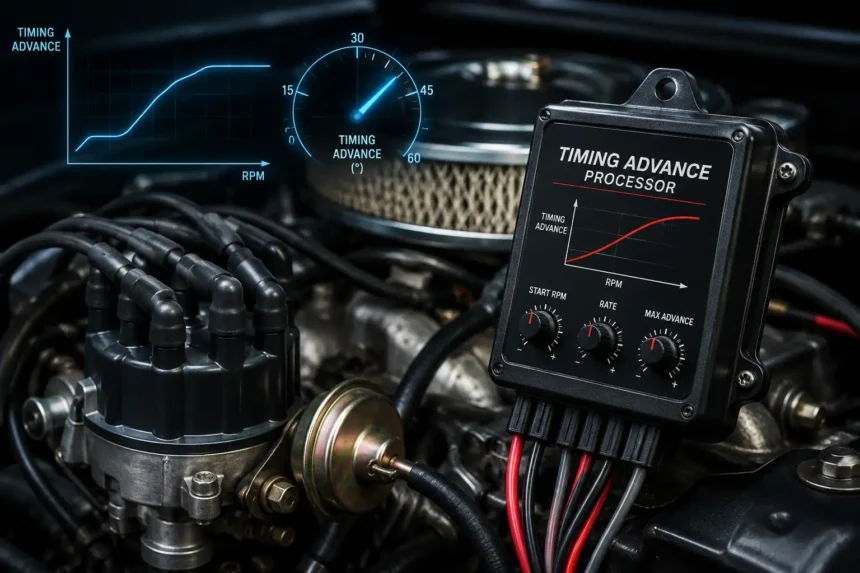
A timing advance processor (TAP) is an electronic control unit that adjusts ignition timing when a vehicle runs on CNG or LPG instead of petrol. These alternative fuels burn more slowly than gasoline, which means the spark plug needs to fire earlier to maintain proper combustion. Without this adjustment, engines lose power, consume more fuel, and can knock or stall.
- What Is a Timing Advance Processor
- How Does a Timing Advance Processor Work
- Types of Timing Advance Processor
- Timing Advance Processor Selection Guide
- Timing Advance Processor Installation and Setting Procedures
- Emergency Connector Functionality
- Troubleshooting Common Timing Advance Processor Issues
- Benefits of Using a Timing Advance Processor
- Timing Advance Processor for Carburetor Engines
- Conclusion
- FAQs
- What is a timing advance processor, and what does it do?
- Do carburetor engine vehicles need a timing advance processor?
- How do I choose the right timing advance processor for my vehicle?
- What is the safe range of timing advance for CNG or LPG engines?
- Is it necessary to recalibrate the timing advance processor periodically?
- What occurs if the timing advance processor experiences a failure or malfunction?
- Will a timing advance processor void my car’s warranty?
- Can a timing advance processor work with fuels other than CNG or LPG?
TAPs solve this problem automatically. They intercept the ignition signal, apply a calibrated offset, and send a corrected signal to the ignition coil — all without permanent changes to the OEM system.
What Is a Timing Advance Processor
A timing advance processor is a compact electronic device installed between the engine’s ignition signal source and the ignition coil. Its core job is to shift the spark timing forward when the engine runs on alternative fuel, then restore factory timing when it switches back to petrol.
When a vehicle converts to CNG or LPG, the combustion characteristics change significantly. Natural gas and LPG have slower flame propagation speeds compared to gasoline. If the spark fires at the original petrol-timed position, the fuel doesn’t fully combust before the piston moves past its optimal point. The result is lost power, rough running, increased fuel consumption, and, in some cases, backfiring.
The TAP corrects this by advancing the spark by a set number of degrees — typically between 6° and 15°, depending on the engine type and fuel. Most units also include an idling setting that disables the advance at low RPM, preventing a rough idle. When the driver switches back to petrol, the processor resets to the original degrees automatically.
How Does a Timing Advance Processor Work
Ignition Timing Fundamentals
Ignition timing refers to the exact moment the spark plug fires relative to piston position, measured in degrees before top dead center (BTDC). For maximum power, the air-fuel mixture must fully combust just as the piston reaches TDC, pushing it down with full force on the power stroke.
When timing is too early (over-advanced), combustion pressure builds while the piston is still rising — this causes knocking or pinging, and can damage cylinder walls, pistons, and bearings over time. When timing is too late (retarded), the explosion happens after the piston has already started downward, reducing power output and raising exhaust temperatures.
The correct ignition timing changes with engine speed (RPM), load, and the type of fuel being burned. CNG and LPG require earlier spark ignition because their slower burn rate means combustion takes longer to complete.
TAP Signal Processing Mechanism
The TAP sits in the signal path between the ignition trigger source and the ignition coil. Here is what happens during the operation:
- Signal interception — The processor reads the incoming ignition trigger signal from the distributor, crankshaft sensor, or ignition module
- Offset application — It applies a programmed advance of 0°–30° depending on the setting
- Modified signal output — The corrected signal fires the coil earlier, advancing the spark
- Idle exclusion — At idle, the advance is disabled to prevent rough idling
- Petrol mode reset — When switched back to petrol, the TAP returns timing to factory specs
Most units include an emergency bypass connector. If the TAP malfunctions, this connector shorts the device out of the circuit, allowing the vehicle to run on standard factory timing without visiting a workshop.
Types of Timing Advance Processor
Different ignition system designs require different TAP models. Using the wrong unit can cause engine errors, misfires, or no-start conditions.
Mechanical Breaker Point Systems
Vehicles manufactured before the mid-1980s used mechanical contact breaker points inside the distributor to trigger ignition. These systems run on low-voltage signals and require TAPs designed specifically for their basic electrical architecture.
The AEB531 is the standard unit for breaker point systems. It connects between the distributor’s negative terminal and the ignition coil’s negative terminal, intercepting the low-voltage null signal from the contact breaker. Its timing range covers 0–25°, and it is compatible with both LPG and CNG conversions.
Electronic Ignition Systems
From the mid-1980s through the 1990s, most vehicles moved to electronic ignition. These systems eliminated contact breaker points but retained the distributor for spark routing. An electronic switching component replaced the mechanical points.
For these vehicles, the AEB515N reprogrammable TAP is the preferred option. It includes adjustable timing advance curves, making it adaptable across a wide range of engine configurations. The reprogrammable function means one unit can be tuned to fit multiple vehicle models by adjusting parameters for specific engines and fuels.
CKP Sensor-Based Systems
Modern engines use a crankshaft position (CKP) sensor to feed precise timing data directly to the engine control unit (ECU). These are fully electronic systems with no distributor. They require TAPs that can accurately read and modify digital sensor signals without triggering fault codes.
TAPs for CKP-based systems process the digital output from the crankshaft sensor and insert a calibrated timing offset before the signal reaches the ECU. Compatibility with the specific ECU behavior and signal voltage is critical for these installations.
Timing Advance Processor Selection Guide
Choosing the right TAP depends on three primary factors:
| Factor | What to Check |
| Ignition system type | Breaker points, electronic distributor, or CKP sensor |
| Fuel system type | MAP sensor, MAF sensor, analog or frequency signal |
| Engine configuration | Naturally aspirated, injected, carburetor, or turbo |
For injection vehicles, confirm whether the fuel system uses a MAP sensor or MAF sensor and whether the signal output is analog or frequency-based. Many TAPs are designed for one signal type only. Using an analog unit on a frequency-type system produces inaccurate timing adjustments.
AEB offers a comprehensive product range covering all three ignition system categories. For carburetor-based injection vehicles, always verify sensor type before purchasing. Consulting a qualified CNG/LPG installer before conversion is strongly recommended — especially for vehicles with modern ECUs or drive-by-wire throttle systems.
Timing Advance Processor Installation and Setting Procedures
TAP installation follows a consistent process across most ignition system types:
- Disconnect the battery before touching any ignition wiring to prevent electrical damage
- Identify connection points based on the ignition system — distributor terminal, CKP wiring, or ignition module output
- Connect according to the manufacturer’s wiring diagram — incorrect wiring causes ignition errors or engine damage
- Set the advanced degree using the processor’s adjustment controls — start conservatively and increase in small increments.
- Test under load — check for knocking, misfires, or power drop at various RPM ranges.s
- Verify petrol mode reset — confirm the TAP returns to factory specifications when switching fuel.
Some modern TAPs include plug-and-play wiring harnesses for specific vehicle models, significantly reducing installation time and wiring error risk.
Emergency Connector Functionality
Every quality timing advance processor includes an emergency bypass connector. This is a short-circuit connector designed to remove the TAP from the ignition circuit instantly if the device fails or produces incorrect timing.
With the emergency connector inserted, the ignition system reverts to its original factory timing, bypassing the TAP entirely. The vehicle can be driven normally on petrol without any performance loss. This safety feature ensures drivers are never stranded due to a TAP malfunction.
Technicians also use the emergency connector during diagnostics — disconnecting the TAP temporarily to confirm whether an ignition issue originates from the processor or elsewhere in the system.
Troubleshooting Common Timing Advance Processor Issues
| Symptom | Likely Cause | Fix |
| Engine knocking on CNG/LPG | Over-advanced timing | Reduce advanced degrees |
| Power loss on gas | Under-advanced or faulty TAP | Increase advance or test bypass |
| Rough idle on alternative fuel | Idle exclusion not active | Check the idle exclusion setting |
| Misfires or hard start | Wrong TAP for ignition type | Verify compatibility |
| ECU fault codes | Signal voltage mismatch | Check analog/frequency type |
| Knocking after switching to petrol | Petrol reset not working | Inspect the reset circuit or replace the TAP |
Over time, engine wear changes combustion characteristics. A TAP calibrated during the original installation may need recalibration after significant mileage. Periodic maintenance checks should include verifying that the advance setting remains appropriate for the current engine condition and operational characteristics.
Benefits of Using a Timing Advance Processor
Running an engine on CNG or LPG without adjusting ignition timing wastes fuel and reduces power. A properly calibrated TAP delivers measurable improvements:
- Better combustion — spark fires at the optimal point, extracting maximum energy from alternative fuel
- Improved fuel efficiency — proper ignition timing reduces incomplete combustion and wasted fuel
- Power boost — drivers typically notice stronger pickup and reduced hesitation, closer to petrol performance
- Lower emissions — efficient combustion produces fewer unburned hydrocarbons in exhaust gases
- Backfire prevention — correct timing eliminates the late-combustion events that cause exhaust backfiring
- Engine protection — avoids the long-term stress caused by chronic knocking on improperly timed CNG or LPG
Timing Advance Processor for Carburetor Engines
Carburetor-based engines (CARB cars) occupy a unique position in the TAP discussion. Because these vehicles use a distributor with a mechanical advance mechanism, timing can technically be adjusted by physically rotating the distributor — no electronic TAP required.
However, the tradeoff is significant. If the distributor is advanced for CNG operation, petrol performance suffers. The engine will knock on petrol because the timing is no longer calibrated for gasoline’s faster burn rate.
Fitting an advancer to a carburetor car solves this. Suzuki’s factory CNG lineup, including several ff models, came with advancers installed from the factory — confirming that TAP use on carburetor engines is both practical and established.
For vehicles like a Mitsubishi Lancer (4G13 engine, 12 valve, 1.3 litre, 5-speed manual), converted using kits such as lo. gas (Italy) with an Inflex (Argentina) cylinder, an advancer removes the need to compromise timing between the two fuels. The idle RPM issue commonly reported after CNG conversion is typically resolved through the throttle adjustment screw, not the TA, but proper advance settings contribute to stable idle performance overall.
Conclusion
A timing advance processor is a straightforward but essential component for any CNG or LPG conversion. Without it, alternative fuels burn inefficiently, power drops, and engines sustain unnecessary wear. With the right TAP correctly installed and calibrated, the gap between petrol and gas performance narrows significantly.
Selecting the correct unit — AEB531 for older breaker point systems, AEB515N for electronic distributors, or a CKP-compatible model for modern ECUs — determines whether the conversion performs well or creates ongoing problems. Proper installation, conservative initial advance settings, and periodic recalibration keep the system running accurately over time.
For carburetor engines, an advancer remains a worthwhile addition even when mechanical distributor adjustment is possible. The ability to run optimally on both fuels without compromise is the core value of the timing advance processor.
FAQs
What is a timing advance processor, and what does it do?
A timing advance processor is an electronic control unit that modifies ignition timing when a vehicle runs on CNG or LPG. It advances the spark by a set number of degrees to compensate for the slower burn rate of alternative fuels, then resets to factory specs when the engine switches back to petrol.
Do carburetor engine vehicles need a timing advance processor?
Carburetor cars can adjust timing mechanically through the distributor, so a TAP is not strictly required. However, without an advanced system, optimizing timing for both CNG and petrol simultaneously is impossible. Running advanced distributor timing on petrol causes knocking. Fitting an advancer is the cleaner solution.
How do I choose the right timing advance processor for my vehicle?
Identify the ignition system type first — breaker points, electronic distributor, or CKP sensor. Then confirm the fuel system’s signal type (MAP or MAF, analog or frequency). Match the TAP model to both. AEB offers vehicle-specific units for each category. Consulting a CNG/LPG installation expert before purchasing is recommended.
What is the safe range of timing advance for CNG or LPG engines?
For most naturally aspirated engines, 6°–10° of additional advance is generally safe on LPG or CNG. Forced-induction engines need less advance due to higher cylinder pressure. Always start at the lower end, monitor for knock under load, and follow manufacturer guidelines or consult a tuning expert before increasing beyond 10°.
Is it necessary to recalibrate the timing advance processor periodically?
Yes. Engine wear changes combustion efficiency over time. A TAP set correctly at installation may become slightly off after significant mileage. Periodic maintenance should include checking whether the advanced setting still matches current engine conditions and adjusting operational characteristics accordingly.
What occurs if the timing advance processor experiences a failure or malfunction?
Most TAPs include an emergency bypass connector. Inserting this connector shorts the TAP out of the circuit and returns the ignition system to factory timing. The vehicle runs normally on petrol with no performance loss, allowing the driver to reach a workshop without being stranded.
Will a timing advance processor void my car’s warranty?
It may. Aftermarket devices that alter sensor signals or emissions-related components can give dealers grounds to deny warranty claims on affected systems. Check the terms of your vehicle warranty before installation, particularly for newer vehicles with complex ECU systems.
Can a timing advance processor work with fuels other than CNG or LPG?
Standard TAPs are designed specifically for CNG and LPG fuel detection circuits. They are not designed for E85 ethanol blends, which require dedicated flex-fuel sensors and separate tuning solutions. Some newer units from manufacturers like AEB and STAG offer broader compatibility, but ethanol applications require purpose-built systems rather than a standard timing advance processor.