

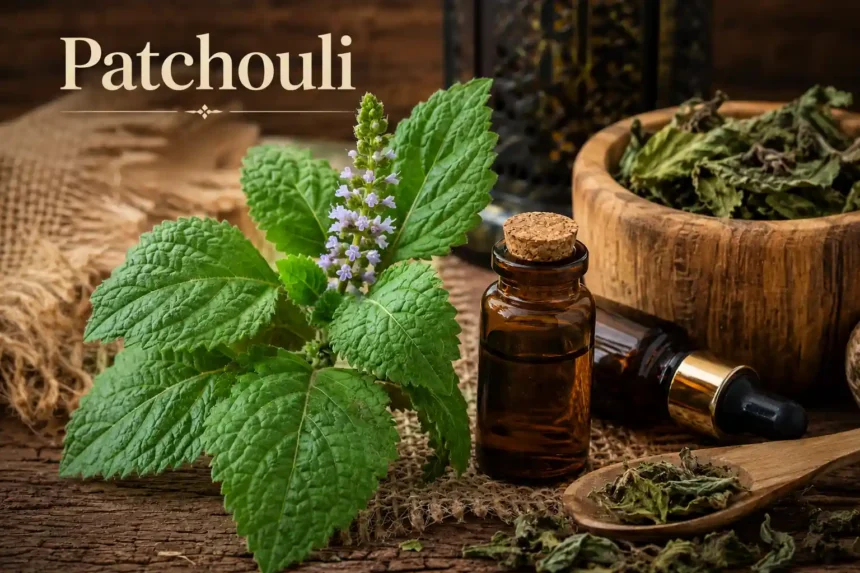
Patchouli (Pogostemon cablin) is an aromatic herb from the mint family, Lamiaceae, cultivated primarily for its essential oil. That oil is one of the most widely used fragrance ingredients in the world — found in perfumes, cosmetics, incense, candles, and skincare products. Its scent is earthy, woody, musky, and slightly sweet, making it a powerful and distinctive presence in any formulation it enters.
- What Is Patchouli?
- History and Origins of Patchouli
- Harvesting and Extraction of Patchouli Oil
- Patchouli Essential Oil: Properties and Benefits
- Patchouli in Perfumery
- Role as a Base Note and Fixative
- Fragrance Pairings and Combinations
- How to Incorporate Patchouli Into Fragrance Compositions
- Patchouli in Modern Perfumery and Popular Fragrances
- Patchouli Uses Beyond Perfumery
- The Resurgence and Evolving Nature of Patchouli
- Conclusion
- FAQs
- What does patchouli smell like?
- What plant does patchouli come from?
- How is patchouli essential oil made?
- What benefits does patchouli essential oil offer?
- Why is patchouli used as a base note in perfumery?
- What fragrances pair well with patchouli?
- What is the difference between light and dark patchouli oil?
- Why was patchouli associated with the hippie movement?
Few natural ingredients carry the same cultural weight and commercial staying power. From ancient trade routes to modern designer fragrances, patchouli has remained relevant for centuries.
What Is Patchouli?
Patchouli is a shrubby perennial plant that grows up to 1 metre (3 feet) tall. Its large, oval-shaped leaves are irregularly toothed and grow in opposite pairs along branching, densely hairy stems. The small pale purple to white flowers appear in dense woolly spikes with long stamens.
The plant is native to Southeast Asia — specifically Indonesia, Malaysia, the Philippines, and India — where it thrives in tropical climates. Most commercial plants are propagated from cuttings rather than seeds. The fragrant leaves are the source of everything: the oil, the scent, and the wide range of applications that follow.
The term originates from two traditional Tamil words: patchai (green) and ellai (leaf). Quite literally, it means “green leaf.”
History and Origins of Patchouli
Patchouli’s documented history stretches back well over a thousand years. It originated in Southeast Asia, where indigenous populations in India, Malaysia, and Indonesia first used it medicinally — brewed into herbal teas for digestive ailments, applied topically for skin conditions, and added to fabrics as an insect repellent.
It travelled westward along the Silk Road, the ancient trade network that connected China with Rome from approximately 130 BCE to 1453 CE, when the Ottoman Empire severed those commercial ties. Merchants valued it so highly that, at one point, a pound of (Pogostemon cablin) was reportedly exchanged for a pound of gold.
A few historical milestones worth noting:
- Ayurvedic medicine: In India, patchouli was used to treat headaches and skin conditions, and as a purifying agent in religious ceremonies.
- Paisley shawls: During the 19th century, patchouli leaves were layered between Paisley shawls to repel moths during long voyages. When these shawls arrived in Europe, their distinctive scent became fashionable — largely popularized by Empress Eugénie.
- Napoleon Bonaparte: He reportedly transported (Pogostemon cablin leaves from Egypt and used them to protect cashmere and silk goods from insects. This is one of the earliest documented instances of patchouli entering European culture.
- King Tutankhamun: Egyptian records indicate that approximately 10 gallons of patchouli were placed inside the pharaoh’s golden tomb.
- 17th–19th centuries: Patchouli was used as a funerary scent to mask the odor of decomposition during burial ceremonies.
- 1960s–1970s: The counterculture movement adopted this aromatic herb as a symbol of rebellion, freedom, and bohemian self-expression. It became synonymous with the hippie movement and communal living.
Harvesting and Extraction of Patchouli Oil
How Patchouli Leaves Are Harvested
Only the top 3 to 5 tufts of leaves are selected — these upper leaves contain the highest concentration of fragrant oil. Leaves are hand-picked when they reach full maturity, then arranged on bamboo sheets and exposed to sunlight for drying.
During the drying phase, the leaves are turned and shifted regularly to prevent them from touching each other. This avoids mould, uneven fermentation, and overly rapid drying. Once the leaves become crisp and breakable, they are ready for oil extraction. Some producers also use woven baskets to allow controlled fermentation, which enhances the oil’s aromatic depth.
How Patchouli Oil Is Extracted
Two main extraction methods are used:
| Method | Description |
| Steam Distillation | Scalding steam passes through dried leaves, separating the oil. Most common commercially. |
| CO2 Extraction | Supercritical CO2 pulls the oil without heat. Produces a cleaner, more precise aroma profile. |
The yield ratio is significant: roughly 100 kilograms (approximately 200 pounds) of fresh leaves produce just 1 kilogram of essential oil. This ratio, combined with the labour-intensive harvesting process, explains why high-quality aromatic herb oil commands a premium price. Only a handful of distilleries produce oil refined enough to satisfy professional perfumers.
Young vs. Aged Patchouli Oil
This essential oil is amber-coloured and slightly opaque, with a lighter, fruitier character. Over time — much like wine — it matures and deepens.
Aged patchouli oil develops a richer amber hue, a more complex bouquet, and pronounced woody, exotic notes. This is why many perfumers specifically seek out aged or dark versions of this essential oil over younger batches. The difference between light (clear) and dark (aged) this essential oil isn’t just cosmetic — the aromatic profile shifts meaningfully between the two.
Patchouli Essential Oil: Properties and Benefits
Chemical Composition and Unique Properties
Patchouli oil contains two distinctive compounds: patchoulol and norpatchoulenol. These give the oil its characteristic odor profile — warm, deep, earthy, and faintly musky — which no synthetic has fully replicated.
Some research suggests that inhaling this essential oil activates the pituitary gland, which may trigger the release of endorphins. This is partly why the oil has long been associated with relaxation, romance, and sensory grounding.
Its scent is also notably polarizing. Most people either love it or strongly dislike it — there is little middle ground. Perfumers account for this when deciding how prominently to feature it in a formulation.
Skin and Health Benefits
Patchouli essential oil is used in both dry and oily skin care. Research supports several practical applications:
- Helps diminish the look of wrinkles, scars, and stretch marks
- Helps manage dandruff, dermatitis, and peeling skin
- Used topically for fungal skin infections and eczema
- Applied in baths to ease rheumatism
- Leaves are brewed into herbal tea for digestive ailments
- Long-standing use as an insect repellent against flies and moths
Aromatherapy Benefits
In aromatherapy, this essential oil works by engaging the brain’s scent receptors in a way that promotes emotional balance and relaxation. It is not simply a pleasant smell — its therapeutic properties have made it a consistent fixture in wellness practices across multiple cultures. The oil is used to reduce anxiety, support grounding, and create a sense of calm.
Patchouli in Perfumery
Role as a Base Note and Fixative
The scent functions almost exclusively as a base note in fragrance formulations. Base notes are the final layer a nose perceives — they develop slowly, last the longest, and give a fragrance its depth and staying power.
Beyond depth, this essential oil acts as a fixative. It anchors and stabilises the other components in a perfume, slowing their evaporation and extending the overall scent profile. A single drop on a blotter can remain detectable for months. This fixative quality makes it exceptionally valuable to perfumers working across fragrance families.
Fragrance Pairings and Combinations
The scent blends well across a wide range of fragrance families:
- Floral: rose, lavender, jasmine, ylang ylang
- Oriental/Amber: frankincense, myrrh, labdanum, resins
- Woody: sandalwood, vetiver, cedar
- Citrus: bergamot, orange, mandarin
- Spicy: clove, clary sage, cinnamon, cardamom
It appears in chypre and Ambrée constructions, powdery fragrances, and oriental perfumes. When paired with rose, it extends and deepens rose’s sweetness. Alongside vetiver, it adds an earthy, smoky dimension that grounds an otherwise airy composition.
How to Incorporate Patchouli Into Fragrance Compositions
Professional perfumers treat the scent carefully. Its earthy notes can overwhelm a blend if used in excess. The standard approach:
- Select complementary ingredients first — citrus, florals, or woods — to establish the scent structure.
- Introduce the scent in a small quantity, then gradually adjust to reach the desired intensity.
- Allow the blend to mature for several days. The scent mellows over time and integrates more harmoniously after resting.
Precise measuring and controlled experimentation are essential. The goal is a balanced, harmonious formulation where the scent adds depth without dominating.
Patchouli in Modern Perfumery and Popular Fragrances
Patchouli appears in some of the best-known fragrances ever created. It is not a niche ingredient — it is a mainstream workhorse of the fragrance industry.
Notable examples include Chanel Chance, Coco Mademoiselle, Thierry Mugler Angel, and Viktor&Rolf Flowerbomb. From niche houses, it features in Jovoy Psychédelique, Cartier L’Heure Décu VII, and L’Artisan Parfumeur Patch.
Clive Christian’s 1872 Feminine uses patchouli as a base note beneath bergamot and rose de mai. Their X Feminine builds a floral chypre around it, pairing the scent with sandalwood, vetiver, vanilla, musk, and rum. I Woody Floral combines it with mandarin, jasmine, muguet, and oud — demonstrating how broadly patchouli functions across different fragrance personalities.
High-end perfumery increasingly relies on it not as a retro throwback, but as a sophisticated structural ingredient that elevates the complexity of an olfactory profile.
Patchouli Uses Beyond Perfumery
Patchouli’s applications extend well beyond fragrance:
- Personal care: soaps, deodorants, lotions, cosmetics
- Home fragrance: candles, incense, diffuser oils, reed diffusers
- Skincare: oil used in serums and creams for aging and irritated skin
- Practical/household: moth repellent for clothing, insect deterrent
- Traditional medicine: Ayurvedic treatments, herbal teas, religious ceremonies
Its fixative properties make it useful in soap and detergent manufacturing, too, where the longevity of scent in the finished product matters.
The Resurgence and Evolving Nature of Patchouli
By the 1980s, patchouli had accumulated significant cultural baggage. Its association with the hippie movement, communal living, and the counterculture revolution of the 1960s left many consumers reluctant to embrace it.
The rehabilitation happened gradually. Perfumers began recontextualising it — stripping away its reputation and demonstrating how effectively it functions in contemporary, high-end fragrance. Today, it appears in mainstream designer perfumes and niche powerhouse releases with equal confidence.
What changed was not the ingredient itself but how it was used. Modern formulations pair patchouli with fresh citrus, clean musks, and transparent florals — creating compositions that feel current and sophisticated rather than heavy or dated. Its depth and complexity remain unchanged; its context simply evolved.
Conclusion
Patchouli is one of the most versatile and enduring ingredients in perfumery. As a base note and fixative, it gives fragrances depth, longevity, and structure that few other naturals can match. Its benefits extend into skincare, aromatherapy, and traditional medicine — making it genuinely multifunctional, not just fragrant.
What makes patchouli remarkable is how it has outlasted every era it has passed through. Ancient trade routes, royal tombs, bohemian counterculture, and modern designer houses have all found a use for it. That kind of enduring appeal does not happen by accident. It reflects a material with real, irreplaceable qualities — earthy, woody, and complex in ways that continue to make it indispensable.
FAQs
What does patchouli smell like?
Patchouli has a deep, earthy, woody, and musky scent with sweet and slightly spicy undertones. Some describe hints of smokiness or cedar. The aroma is warm, exotic, and complex — and notably intense, which is why perfumers use it in small quantities.
What plant does patchouli come from?
Patchouli comes from Pogostemon cablin, a perennial herb in the mint family (Lamiaceae). The plant produces large fragrant leaves and grows natively across Southeast Asia, particularly in Indonesia, Malaysia, and the Philippines.
How is patchouli essential oil made?
The most common method is steam distillation, where scalding steam passes through dried patchouli leaves to separate the oil. CO2 extraction is also used for a cleaner aromatic output. Roughly 100 kilograms of fresh leaves are needed to produce just 1 kilogram of oil.
What benefits does patchouli essential oil offer?
Patchouli oil helps manage dandruff, eczema, dermatitis, and dry or peeling skin. It may reduce the appearance of wrinkles, scars, and stretch marks. In aromatherapy, it promotes relaxation and emotional balance. It also functions as an insect repellent and has a traditional history of use for digestive ailments.
Why is patchouli used as a base note in perfumery?
Patchouli evaporates slowly, which means it contributes to the longevity and depth of a fragrance. As a fixative, it anchors other scent components, slowing their evaporation and extending the overall scent profile. This structural role makes it one of the most reliable base notes available to perfumers.
What fragrances pair well with patchouli?
Patchouli pairs well with rose, lavender, jasmine, and ylang ylang in floral compositions. In oriental or amber blends, it works with frankincense, myrrh, and labdanum. Sandalwood, vetiver, bergamot, clary sage, cinnamon, and cardamom are also strong companions depending on the intended character of the fragrance.
What is the difference between light and dark patchouli oil?
Light (clear) patchouli is produced through refined distillation and has a smoother, less intense aroma. Dark (aged) patchouli undergoes extended distillation and maturation, resulting in a deeper, richer, and more robust scent with pronounced earthy and woody notes. Most high-end perfumers prefer aged patchouli for its complexity.
Why was patchouli associated with the hippie movement?
In the 1960s and 1970s, patchouli became widely used within counterculture communities. Its strong, earthy scent helped mask odors associated with communal living. It also aligned symbolically with the movement’s values — naturalness, freedom, and rejection of mainstream norms. That cultural association persisted for decades before modern perfumery reclaimed the ingredient.