
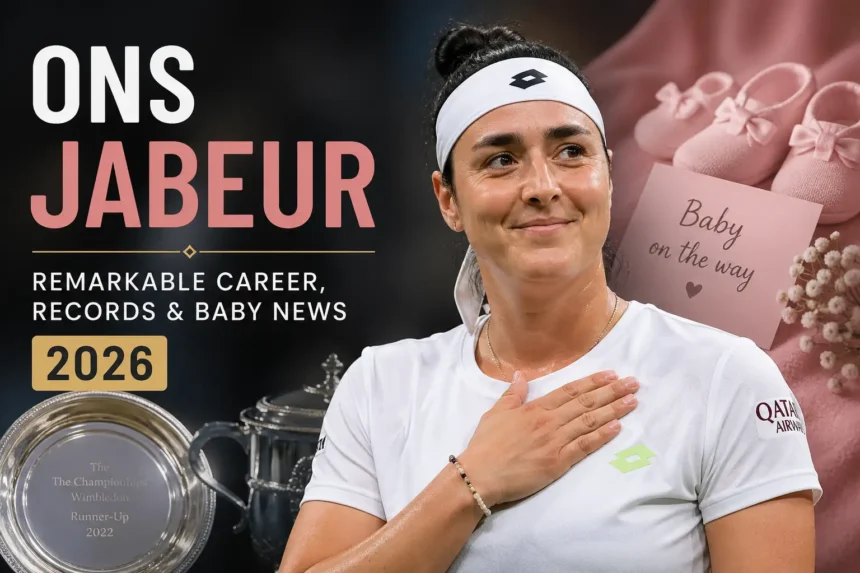
The story of Ons Jabeur is not just a sports story. It is a story about patience, identity, and the particular weight of being first. There is a photograph that circulated across social media in April 2026 — a young Tunisian woman sitting in a hospital bed, her husband beside her, a newborn son wrapped in a blanket printed with tiny tennis rackets. The image said everything without a caption. But Ons Jabeur added one anyway: “A tiny miracle, a lifetime of love.”
- The Girl from Ksar Hellal
- How She Actually Plays
- From ITF Circuits to Grand Slam Courts
- Five Titles and a Record That Will Stand for Years
- Three Grand Slam Finals, Zero Titles — and Why the Record Still Matters
- A Ranking Climb That Made History Twice
- The Full List of Firsts
- The Man Behind the Scenes
- A Tiny Miracle
- The Hardest Season
- Building Something in Dubai
- What She Has Earned Along the Way
- What Comes Next
- Conclusion
- FAQs
It was, in many ways, the perfect summary of who she is. A woman who has spent her entire adult life chasing something extraordinary — on court and off it.From a tennis club in Ksar Hellal to the grass courts of Wimbledon.
The Girl from Ksar Hellal
She was three years old when her mother, Samira, first took her to the tennis club. Samira loved the game and would bring young Ons along to keep her occupied. What happened next was not planned — Ons picked up a racket, refused to put it down, and never really looked back.
Born on August 28, 1994, in Ksar Hellal, a modest city in the Monastir region of Tunisia, she grew up as the youngest of four children. Her father, Ridha, her brothers, Hatem and Marwen, and her sister, Yasmine, formed the household around her. By age 10, the family supported a decision that most parents would find difficult — Ons moved from Sousse to Tunis alone to train full time.
She woke at 5 am. She practiced until evening. She studied between sessions. At an age when most children are figuring out friendships, she was navigating the loneliness of living away from home to chase a sport she loved.
That early grounding built something in her that raw talent alone never could. It built resilience.
Away from the court, she is multilingual — Arabic, English, and French come naturally, and she has been picking up Russian, partly a nod to her husband’s background. She follows Real Madrid and Juventus, plays recreational soccer, and grew up supporting Étoile Sportive du Sahel. As a child, her favorite player was Andy Roddick. She admired his serve. She also admired his sense of humor — a quality she would go on to develop quite prominently herself.
How She Actually Plays
Ask anyone who has watched Jabeur closely, and they will tell you the same thing: she plays tennis like nobody else on the women’s tour.
Where most elite players rely on pace and power to win points, she manufactures them differently. Her game is built on angles, deception, and variety. The forehand and volleys are weapons, but the slice and drop shot are what keep opponents guessing. She can shift the geometry of a rally mid-point in ways that leave even experienced professionals visibly frustrated.
In her junior years, those who trained alongside her nicknamed her “Roger Federer” — not for arrogance, but for the same quality Federer possessed: she played the situation, not just the ball. That instinct for reading a point and responding creatively rather than mechanically is rare at any level. At the elite level, it is almost unique.
She adapts across all surfaces, though her feel for grass and clay is particularly sharp. Her current coach is Issam Jellali, and her fitness trainer since mid-2017 has been Karim Kammoun — her husband — who also works with Tunisia’s national tennis program. The professional and personal have been intertwined throughout her career in ways that seem to have strengthened rather than complicated both.
From ITF Circuits to Grand Slam Courts
Before the world knew her name, Jabeur was grinding through the lower levels of the professional game. She played her first professional event at El Menzah in Tunisia in 2008, at just 14 years old. The ITF Women’s Circuit was her classroom for years — 25k and 50k events across Tunisia, Japan, Canada, and beyond.
She eventually collected 11 singles titles and one doubles title at that level. The wins came steadily: back-to-back 50k titles in Japan in May 2013, a run at the Saguenay Challenger where she defeated CoCo Vandeweghe, and an upset of top seed Bojana Jovanovski at the 2013 Baku WTA event. Each result pushed her up the rankings by inches.
Her WTA main draw debut came in February 2012 — a wildcard at the Qatar Ladies Open in Doha, where she lost to Virginie Razzano in the first round. She would also qualify for the Dubai Tennis Championships that same week, where she upset world No. 33 Zheng Jie despite entering with a ranking of 1169. Small moments, but they confirmed something important about how she competed.
In 2017, she received an International Player Grand Slam Grant from the Grand Slam Development Fund, which helped fund her preparation for the French Open main draw that year.
The Junior Title That Started Everything
Before all of that, though, there was Roland Garros 2011.
Jabeur entered the junior tournament as the ninth seed, having only recently returned from left wrist surgery. She had the operation in November 2010, missed five months of tennis, and came back to competition at what was only her third or fourth event back. Most players in that situation play conservatively, grateful just to be competing again. She went to Paris and won the whole thing.
She defeated Daria Gavrilova in the quarterfinals, Caroline Garcia in the semifinals, and Monica Puig in the final. The title made her the first North African woman to win a junior Grand Slam, and the first Arab girl to claim a junior major singles crown since Ismail El Shafei secured the boys’ title at Wimbledon back in 1964.
That same year, she had also partnered with Ashleigh Barty in doubles at the Junior International Roehampton. She had reached the Roland Garros junior final in 2010, too, losing to Svitolina, which meant the 2011 title came with the added satisfaction of going one step further than she had the year before.
It was the first real signal that something significant was developing.
Three Olympic Campaigns
Jabeur has represented Tunisia at the Olympic Games three times, starting with London 2012. She has been equally consistent in the Billie Jean King Cup, compiling a singles record of 28–5 and a doubles record of 9–8 since her Zone Group III debut in 2011. For a player often celebrated for individual achievements, her commitment to national representation has been quietly steady throughout.
Five Titles and a Record That Will Stand for Years
By the time her professional career reached its peak, Jabeur had won five WTA singles titles spanning three different tournament tiers.
| Year | Title | Surface | Defeated in Final |
| 2021 | Birmingham Classic | Grass | Daria Kasatkina |
| 2022 | Mutua Madrid Open (WTA 1000) | Clay | Jessica Pegula |
| 2022 | Berlin | Grass | Belinda Bencic |
| 2023 | Charleston | Clay | Belinda Bencic |
| 2023 | Ningbo | Hard | Diana Shnaider |
The Birmingham title on June 20, 2021, carried the most immediate historical weight — it made her the first Arab woman to win a WTA title, full stop. But the Madrid victory in 2022 was arguably the bigger competitive achievement: a WTA 1000 event, clay surface, defeating Jessica Pegula in three sets. No Arab or African woman had done that before either.
Her 2018 Moscow run also deserves mention. As a qualifier at the Kremlin Cup, she defeated three top-25 players — including Sloane Stephens and Anastasija Sevastova — before losing the final to Daria Kasatkina. It was her first WTA final, and it signaled to the tour that a different kind of competitor had arrived.
Three Grand Slam Finals, Zero Titles — and Why the Record Still Matters
Between 2022 and 2023, Jabeur reached three Grand Slam finals. None ended with a trophy. Each loss left its own mark.
- Wimbledon 2022 — Lost to Elena Rybakina, 3-6, 6-2, 6-2
- US Open 2022 — Lost to Iga Świątek in straight sets
- Wimbledon 2023 — Lost to Marketa Vondrousova
The outcomes hurt. But the context matters enormously. No Arab or African woman had reached a Grand Slam final in the Open Era before that 2022 Wimbledon run. The previous African woman to contest a major final had done so in 1959. Jabeur did not just reach these finals — she did it in back-to-back Slams in the same year, a level of sustained excellence that very few players ever achieve.
A Ranking Climb That Made History Twice
Her ascent through the WTA rankings told its own story.
| Milestone | Ranking | When |
| Career-high | No. 2 | June 27, 2022 |
| Entered Top 10 | No. 10 | October 18, 2021 |
| First Top 50 | No. 45 | Post-2020 Australian Open |
| Year-end 2023 | No. 6 | December 2023 |
| Year-end 2024 | No. 42 | December 2024 |
| Year-end 2025 | No. 75 | December 2025 |
| April 2026 | No. 345 | Extended absence |
The No. 2 ranking she achieved on June 27, 2022, made her the highest-ranked African and Arab player in the combined history of both WTA and ATP rankings. Her full ranking history is documented on her WTA Tour profile. No man or woman from the Arab world had climbed higher — a fact that lands differently when you consider how long the sport has existed.
The Full List of Firsts
It is worth reading this list slowly, because each entry represents a barrier that existed until she removed it:
- First Arab woman to win a WTA title — Birmingham, 2021
- First Arab woman to reach a Grand Slam quarterfinal — Australian Open, 2020
- First Arab or African woman to win a WTA 1000 event — Madrid, 2022
- First African and Arab woman to reach a Grand Slam singles final — Wimbledon, 2022
- First Arab player, male or female, to rank inside the world’s top 10
- First Tunisian woman to reach a Grand Slam final
- First North African woman to win a junior Grand Slam title
She won the Arab Woman of the Year award in the sports category in 2019. After her 2022 Wimbledon run, Tunisia’s postal service, Post Tunisie, released a commemorative stamp featuring her holding the national flag. In a country where football dominates, that gesture meant something.
The Man Behind the Scenes
Karim Kamoun entered Jabeur’s life long before he became her trainer. The couple had been together for years before marrying in November 2015. Russian-Tunisian by heritage, Kamoun was a professional fencer in a previous chapter of his life. He transitioned into fitness coaching and began working formally with Jabeur in mid-2017.
His role expanded beyond the physical. As both husband and fitness trainer, he occupied a position that required a particular kind of steadiness — someone who could separate the professional from the personal without losing either. By all accounts, they managed that balance well. He also holds a position within Tunisia’s national tennis program, which gives their partnership a broader meaning beyond just their own careers.
A Tiny Miracle
In November 2025, Jabeur posted a video to Instagram that stopped the tennis world mid-scroll. She and Kamoun jumped into frame — she holding a tiny tennis-themed onesie, he gripping a miniature racket. Beyoncé and Ed Sheeran’s Perfect played underneath. The caption read: “The court can wait a bit longer—because soon, we’ll be welcoming our newest and smallest teammate.”
The pregnancy had been announced. The due date: April 2026.
On April 20, 2026, Elyan Kammoun arrived. Jabeur shared the news the following morning with a single photograph: the three of them in a hospital room, surrounded by flowers, Elyan swaddled in a blanket covered in tennis rackets. Her caption was simple: “A tiny miracle, a lifetime of love.”
The response from the tennis world was immediate and warm. Coco Gauff, Elina Svitolina, Leylah Fernandez, Emma Raducanu, and Barbora Krejčíková all commented. Paula Badosa wrote that she could not wait to meet him. Chris Evert sent a personal message to both parents. Naomi Osaka, Caroline Wozniacki, and Taylor Townsend — all players who have navigated the intersection of motherhood and professional sport — offered their congratulations with a particular understanding of what this moment meant.
The Hardest Season
To understand April 2026, you have to go back to July 2025. Jabeur walked off the Wimbledon courts mid-match against Viktoriya Tomova — the score 7-6(5), 2-0 — and did not return to professional competition. The announcement that followed was more honest than most athletes allow themselves to be in public.
She had been pushing through injuries for two years. A shoulder problem had already forced her out of the 2024 US Open and effectively ended that season in Toronto in August. She had come back in 2025, made quarterfinal runs at Brisbane, Abu Dhabi, Doha, and Berlin, and then ran out of road at Wimbledon.
But the injury was only part of the story. She disclosed publicly that she had been experiencing depression. That she had not felt genuinely happy on court for some time. The BBC interview in which she spoke about this was notable for its directness — no vague references to needing rest, just a clear account of what had actually been happening.
Her ranking, which had sat at No. 6 at the end of 2023, slid to No. 42 by the end of 2024, then to No. 75 at the close of 2025. By April 2026, with the extended absence accumulating, it had fallen to No. 345 — a drop of 270 places from the start of the year.
She has been consistent about one thing, though: retirement is not the plan. Speaking to Vogue Arabia in March 2026, she said she wanted to return to the tour and compete for a couple more years, but on her own timeline, and only when her body was ready.
Building Something in Dubai
While the court waited, Jabeur kept moving. In late 2025, she launched the OJ Tennis Academy in Dubai, in partnership with Emirati investment company Capital H. The academy serves both young developing athletes and amateur players, with an emphasis on high-level coaching and structured progression.
“A place designed for progress, ambition, and world-class training,” she wrote at the launch.
The project reflects something she has talked about for years — the idea that her influence extends beyond her own results. She has consistently spoken about wanting to make tennis more accessible in the Arab world, and an academy in Dubai positions her to act on that directly, whether or not she is competing herself.
What She Has Earned Along the Way
Career prize money stands at approximately $5,813,092. Her estimated net worth sits around $6.5 million. She holds an equipment endorsement deal with Wilson, which has been a consistent part of her professional setup for years.
The WTA Maternity Fund Programme, built in partnership with Saudi Arabia’s Public Investment Fund, has provided structural support during her pregnancy — offering protected rankings, up to 12 months of paid maternity leave, and fertility grants. Jabeur praised the programme publicly, calling it unbelievable and crediting PIF and the WTA for making it possible.
The broader significance of that programme has grown in recent seasons. Naomi Osaka, Angelique Kerber, Caroline Wozniacki, Elina Svitolina, and Tatjana Maria have all demonstrated that motherhood and a WTA comeback are compatible. Jabeur will almost certainly become the next significant example of that.
What Comes Next
The tennis world does not expect her to disappear. Those who have followed her career closely know that she has come back from things before — wrist surgery at 16, years of near-misses on the ITF circuit, defeats in three Grand Slam finals that would have broken other players’ confidence.
She is 31. Her peak ranking was two. She has five WTA titles, three major finals, and a list of historical firsts that no one will replicate. And now she has a son named Elyan, a tennis academy in Dubai, and a court that, in her own words, will have to wait just a little longer.
Given everything she has managed to do when people were not quite expecting it, that is probably the last thing anyone should underestimate.
Conclusion
Ons Jabeur has spent over a decade reshaping what is possible for Arab and African women in tennis. From her junior Roland Garros title in 2011 to three Grand Slam finals and a career-high No. 2 ranking, her record stands apart. Off the court, she has launched an academy in Dubai and welcomed her son Elyan into the world. The WTA Tour will be watching for her return — and given everything she has already overcome, few would bet against it.
FAQs
Who is Ons Jabeur?
Ons Jabeur is a Tunisian professional tennis player born on August 28, 1994, in Ksar Hellal. She reached a career-high WTA ranking of No. 2 in June 2022, making her the highest-ranked Arab and African player in the history of both the WTA and ATP rankings. She is widely known as the Minister of Happiness.
What is Ons Jabeur’s career-high singles ranking?
Her career-high is world No. 2, achieved on June 27, 2022 — following her title run in Berlin and her Wimbledon finalist appearance that same year. No Arab or African player, male or female, had ranked higher in the history of professional tennis.
Who is Ons Jabeur’s husband?
Karim Kamoun is her husband, a Russian-Tunisian former professional fencer who became her fitness trainer in mid-2017. The couple married in November 2015 and has been together for over a decade. He also holds a coaching role within Tunisia’s national tennis program.
Did Ons Jabeur have a baby in 2026?
Yes. She and Karim Kamoun welcomed their son, Elyan Kammoun, on April 20, 2026. Jabeur announced the pregnancy in November 2025 via Instagram and confirmed the birth the following day with a photograph from the hospital.
How many Grand Slam finals has Ons Jabeur played?
Three — Wimbledon 2022 (lost to Elena Rybakina), US Open 2022 (lost to Iga Świątek), and Wimbledon 2023 (lost to Marketa Vondrousova). She was the first Arab and African woman to reach a Grand Slam singles final in the Open Era.
What historic records has Ons Jabeur set?
Her records include: first Arab woman to win a WTA title, first Arab woman to reach a Grand Slam quarterfinal, first Arab or African woman to win a WTA 1000 event, first African and Arab woman to reach a Grand Slam final, and first Arab player of either gender to rank inside the world’s top 10.
Is Ons Jabeur done with professional tennis?
No. She took a hiatus from the tour in July 2025, citing depression and a shoulder injury that had affected her throughout 20244 and 2025. In a March 2026 interview with Vogue Arabia, she stated her intention to return to competition, saying she wants to compete for a couple more years — but on her own timeline.
What is the OJ Tennis Academy?
The OJ Tennis Academy is Jabeur’s first tennis facility, launched in Dubai in partnership with Emirati investment company Capital H. It provides coaching for young athletes and amateur players, focusing on world-class training, structured development, and long-term progression within the sport.