
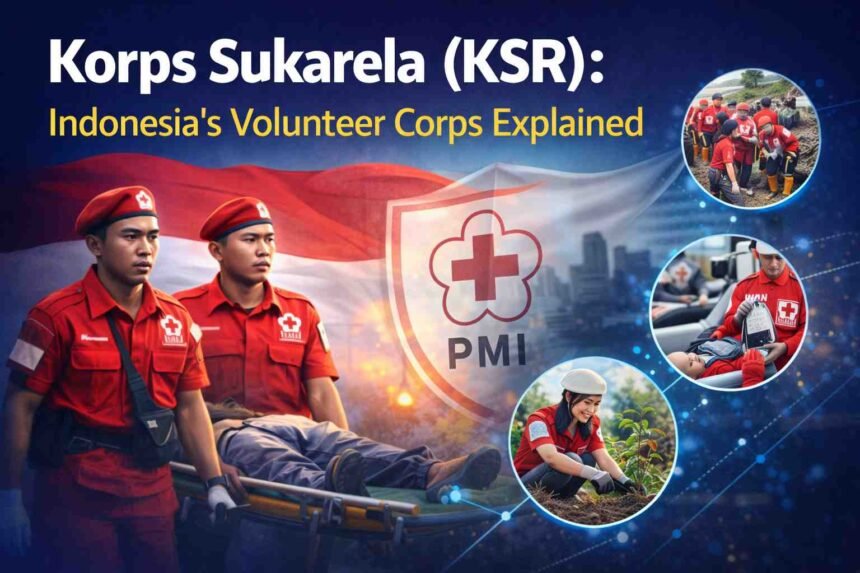
Korps Sukarela is the organized volunteer arm of Palang Merah Indonesia — the Indonesian Red Cross — and it plays a far more active role in Indonesian public life than most people realize. From managing disaster evacuations to running blood donation campaigns on university campuses, KSR members show up where help is needed. This article breaks down who they are, what they do, and why the corps matters in 2026.
- What Is Korps Sukarela (KSR)?
- History and Evolution of Korps Sukarela
- Core Values and Guiding Principles
- Structure and Membership
- Training and Capacity Building
- Primary Activities and Services
- Disaster Response and Emergency Relief
- Health Services and Public Health Campaigns
- Community Development and Environmental Engagement
- Role of KSR in Disaster-Prone Indonesia
- Impact on Public Health and Social Welfare
- KSR vs. Other Volunteer Organizations
- Benefits of Joining Korps Sukarela
- How to Join Korps Sukarela
- Challenges Faced by KSR Volunteers
- Future Directions and Innovations
- Measuring the Impact and Legacy of KSR
- Conclusion
- FAQs
What Is Korps Sukarela (KSR)?
At its core, KSR is a trained volunteer corps operating under PMI — Palang Merah Indonesia. Members are not casual helpers. They go through structured training and commit to active service across disaster response, community health, and social welfare programs.
Most KSR units are based at universities, making university students the largest segment of its membership. But the corps also accepts community members through non-campus PMI branches. Volunteers wear uniforms and operate under a clear humanitarian mandate — they are often described as the ujung tombak, or frontline force, of Indonesian Red Cross operations.
History and Evolution of Korps Sukarela
PMI itself was founded in 1945, shortly after Indonesian independence. The volunteer structure grew from a tradition of gotong royong — the Indonesian concept of mutual community cooperation — and gradually became formalized into what is now a nationally recognized institution.
Early efforts were largely ad hoc. Local groups organized independently through universities and Red Cross offices. Over time, the structure became standardized, with units established across city and district-level PMI branches. What started as grassroots civic participation evolved into a disciplined, training-based organization with coordinated responses to national emergencies.
Core Values and Guiding Principles
KSR operates under the Seven Fundamental Principles shared by the entire International Red Cross and Red Crescent Movement:
- Humanity — relieve suffering without discrimination
- Impartiality — serve based on need, not identity
- Neutrality — take no side in conflicts
- Independence — remain autonomous from political influence
- Voluntary Service — no member serves for financial gain
- Unity — one PMI unit per country
- Universality — the movement applies globally
These principles are not decorative. They shape how volunteers are trained to act in high-pressure situations, particularly when political or social tensions are involved.
Structure and Membership
Organizational Structure
KSR units exist at multiple levels — provincial, city, and district PMI branches. University-based units operate as Unit Kegiatan Mahasiswa (UKM), functioning semi-independently while remaining under their regional PMI Kota/Kabupaten. Each markas (headquarters) coordinates deployment, training, and logistics for its affiliated units.
Membership Requirements
To join, applicants must be at least 18 years old, physically and mentally fit, and willing to complete basic training. Most active members fall within the 18–34 age range. Some branches, like Depok’s PMI unit, offer limited intake — around 30 KSR slots per cycle — which makes recruitment competitive. Education level requirements vary by unit, but commitment to the training process is non-negotiable.
Training and Capacity Building
Basic Training Program
Before any active service, recruits complete diklat dasar — foundational training that typically runs around 76 hours. The curriculum covers:
- First aid and basic life support
- Disaster risk reduction
- Logistics and field communication
- Organizational ethics and Red Cross principles
This is not a symbolic orientation. Recruits are tested on practical skills and must demonstrate readiness before joining active operations.
Specialist Training
After completing basic training, members can pursue advanced tracks. Satgana — disaster readiness squads — receive specialist preparation in mass casualty management, water rescue, sanitation, and psychosocial support. These are the teams deployed to major emergencies where general volunteers are not sufficient.
Primary Activities and Services
Disaster Response and Emergency Relief
Indonesia sits on the Ring of Fire, making it one of the most disaster-prone countries on Earth. Earthquakes, floods, tsunamis, volcanic eruptions, and landslides are recurring events — not rare ones. KSR serves as the grassroots deployment force when these events happen.
Volunteers handle crowd management, set up temporary shelters, distribute relief supplies, and assist with family tracing through PMI’s Restoring Family Links program. In large-scale disasters, Satgana squads take the lead while general volunteers manage logistics and evacuations.
Health Services and Public Health Campaigns
Outside of emergencies, KSR runs regular health-focused programs. Blood donation drives are among the most visible activities, often held on campuses or at community centers. Volunteers also conduct first aid training, support HIV/AIDS awareness, and run disease prevention campaigns focused on personal hygiene and child health.
In underserved areas, these campaigns often represent the only accessible health education some communities receive. Peer counseling programs — remaja sebaya — also address substance abuse and sexual health among youth.
Community Development and Environmental Engagement
KSR’s work extends beyond crisis response. Members participate in community cleanups, tree-planting drives, and waste management projects. Vocational and life-skill workshops run through local branches help build more resilient, self-sufficient communities over time. This longer-term development work — called bakti sosial — reflects PMI’s broader vision for community empowerment beyond emergency services.
Role of KSR in Disaster-Prone Indonesia
Few countries face the combination of hazards that Indonesia does. With active volcanoes, tectonic fault lines, and coastal flood risk, local volunteer capacity is not a luxury — it is essential infrastructure.
KSR’s geographic spread makes rapid deployment possible in ways that centralized agencies cannot match. When a flood hits a rural district, the nearest KSR unit can mobilize within hours. They provide immediate first aid, psychological support for traumatized survivors, and coordination support for incoming relief organizations. Their role as the local backbone of disaster management is well-established across Indonesian emergency response history.
Impact on Public Health and Social Welfare
The cumulative effect of years of blood drives, health campaigns, and peer counseling is difficult to quantify precisely — but the patterns are visible. Communities with active KSR units show stronger health literacy and higher participation in preventive health programs.
During the Covid-19 pandemic, units like those in Solo mobilized under programs such as Solo Lawan Corona, organizing medical check-ups and awareness drives at the community level. Youth-led peer counseling programs have consistently reduced substance abuse rates in areas where formal mental health infrastructure is thin.
KSR vs. Other Volunteer Organizations
FeatureKSR PMIGeneral Volunteer GroupsGovernment Agencies
Training Structured, certified Varies Formal but bureaucratic
Humanitarian focus, Core mandate, Often secondary, Policy-driven
Global recognition, IFRC-affiliated, Rarely Depends on the agency
Youth-centered Yes Sometimes No
Disaster readiness, specialized squads, and limited institutional
KSR’s affiliation with the IFRC and alignment with international humanitarian standards set it apart. Members can participate in international missions and exchange programs — opportunities not available through most local volunteer organizations.
Benefits of Joining Korps Sukarela
Beyond service, volunteers gain practical skills with real-world value. First aid certification, disaster management training, and crisis communication are skills that employers and academic institutions recognize. Many members list KSR experience on resumes and scholarship applications with measurable results.
Personal development is equally significant. Leadership, teamwork, and empathy are embedded in how the corps operates — not taught as abstract values. The network of civic institutions and humanitarian professionals that volunteers connect with often shapes their careers long after they leave active service.
How to Join Korps Sukarela
The process follows a clear sequence:
- Registration — Find a PMI-linked KSR unit at your university or local PMI Kota/Kabupaten
- Orientation — Learn the structure, mandate, and expectations
- Basic Training (Diklat Dasar) — Complete the foundational program
- Membership Confirmation — Formally recognized as an active member
- Active Service — Deploy on campaigns, events, and emergencies
- Continuing Education — Pursue advanced or specialist programs
Community-based KSR units outside academic institutions follow a similar path but are coordinated directly through regional PMI branches.
Challenges Faced by KSR Volunteers
Volunteer retention is an ongoing challenge. Students managing academic workloads often struggle with the time commitment, particularly during exam periods or thesis work. Funding constraints affect how well units can maintain equipment and support logistical costs for remote deployments.
Emotionally, working in disaster zones and with human suffering takes a toll that is rarely discussed openly. Mental health support for volunteers themselves remains underdeveloped in most units, even as KSR trains members to provide psychosocial support to others.
Future Directions and Innovations
Digital tools are reshaping how KSR coordinates. Apps for volunteer deployment, field reporting platforms, and drone mapping for disaster zone assessment are being integrated into operations. Data analysis now supports faster resource allocation during emergencies.
Climate resilience is becoming a central focus. As natural hazards intensify, community-based disaster risk reduction programs are expanding. Partnerships with NGOs and international aid agencies are strengthening both the reach and technical capacity of KSR units across Indonesia.
Measuring the Impact and Legacy of KSR
The numbers accumulate quietly over decades — blood units donated, communities reached, disasters responded to, volunteers retained. What they represent collectively is a culture of volunteerism embedded in Indonesian institutional life.
KSR’s legacy is not just operational. It has helped normalize the idea that ordinary citizens — particularly young people — can take on structured, trained humanitarian roles. That normalization shapes how communities prepare, respond, and rebuild when crises hit.
Conclusion
Korps Sukarela represents something specific and valuable: organized volunteerism with real discipline behind it. The combination of values-based training, disaster response capacity, health outreach, and environmental work makes it a multifaceted force in Indonesian civic life.
For volunteers, it offers belonging, skills, and purpose. For communities, it provides a trained local presence that scales when institutional systems are stretched. As Indonesia faces increasingly complex challenges — climate, public health, rapid urbanization — the role of coordinated community service like KSR only grows in importance.
FAQs
What does Korps Sukarela mean in English?
The name translates directly to “Voluntary Corps.” It is commonly abbreviated as KSR PMI to indicate its connection to Palang Merah Indonesia.
Who can join Korps Sukarela?
University students are the primary membership base, but community members can also join through non-campus PMI branches. Applicants must be at least 18 years old and meet basic physical health requirements.
Is there a fee to join KSR?
There is no monetary fee, but membership requires a significant investment of time and effort, particularly during the basic training program and active service periods.
What training do KSR volunteers receive?
All members complete diklat dasar covering first aid, disaster response, and humanitarian principles. Beyond that, volunteers can pursue specialist tracks in areas like mass casualty management, water rescue, and psychosocial support.
Is KSR internationally recognized?
Yes. Through PMI’s affiliation with the IFRC — International Federation of Red Cross and Red Crescent Societies — KSR members operate under internationally recognized humanitarian standards. They can participate in international missions and exchange programs.
What activities does KSR participate in?
Core activities include disaster response, blood donation drives, health campaigns, community cleanups, youth leadership programs, and environmental projects. The scope varies by unit and regional needs.