
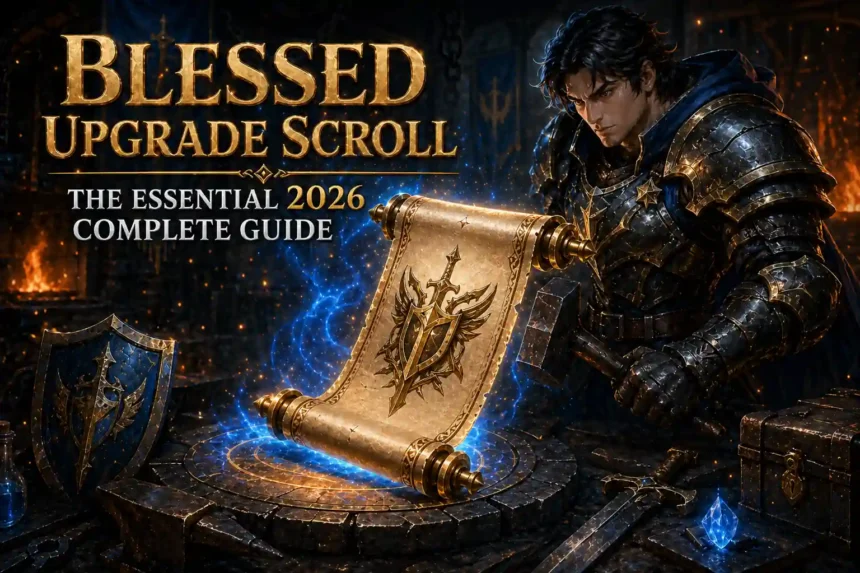
If you’ve ever lost a rare weapon to a failed upgrade, you already know why the blessed upgrade scroll exists. It’s one of the most valuable consumables in online gaming — not because it guarantees success, but because it keeps your gear safe when the odds aren’t in your favor.
- What Is a Blessed Upgrade Scroll?
- How Does a Blessed Upgrade Scroll Work?
- Success and Failure Mechanics
- Anti-Destruction and Item Protection
- Great Success and Multi-Level Jump Mechanic
- How to Use a Blessed Upgrade Scroll Step by Step
- Success Rates by Item Tier and Upgrade Level
- Where to Get a Blessed Upgrade Scroll
- Blessed Upgrade Scroll Farming Guide and Strategies
- Blessed Upgrade Scroll Market Economy and Value
- Blessed Upgrade Scroll in Specific Games
- Common Mistakes to Avoid When Using Blessed Upgrade Scrolls
- Blessed Upgrade Scroll vs Normal Scroll: Key Differences
- Conclusion
- FAQs
- Does a blessed upgrade scroll guarantee success?
- What happens if a blessed upgrade scroll fails?
- Can I use a blessed upgrade scroll with other scrolls at the same time?
- Should I use a blessed upgrade scroll on beginner gear?
- Where can I buy or farm blessed upgrade scrolls fast?
- Can blessed upgrade scrolls be traded or sold?
- Do blessed upgrade scrolls work on accessories and special items?
- How does a blessed upgrade scroll affect the pity system?
This guide covers everything: how it works, when to use it, where to find it, and how to avoid the mistakes that cost players their best equipment.
What Is a Blessed Upgrade Scroll?
A blessed upgrade scroll is a premium in-game item used to enhance weapons, armor, and accessories across dozens of MMORPGs and RPG titles. Unlike regular upgrade scrolls, this one comes with a critical safety net — if the enhancement fails, your gear doesn’t disappear.
Standard scrolls carry real risk. At higher upgrade levels, a failed attempt can destroy the item entirely, resetting weeks or months of progress. The blessed version removes that worst-case outcome. Your item remains intact even if the upgrade doesn’t succeed.
Game developers introduced these scrolls because players were quitting after losing expensive gear to bad RNG. The solution was a scroll that shifted the upgrade experience from a stressful gamble into a calculated, manageable risk.
How It Differs from Regular Upgrade Scrolls
Here’s a direct comparison:
| Scroll Type | On Success | On Failure |
| Normal Scroll | +1 level | Item destroyed or reset to 0 |
| Blessed Scroll | +1 to +3 levels | Item stays intact or drops by 1 |
| Cursed Scroll | Variable | Used strategically for multi-jump setups |
The blessed version also sits at the top of the upgrade scroll hierarchy. Normal scrolls work fine for early-game fodder items. BiS (Best-in-Slot) end-game gear deserves blessed protection — always.
Why Developers Introduced Blessed Upgrade Scrolls
The original MMORPG enhancement systems were brutal. Players would grind for weeks, attempt a +7 upgrade, and watch the item vanish in seconds. Retention rates dropped. Developers noticed.
By introducing the item protection scroll concept, they gave players a way to engage with the upgrade system without the fear of catastrophic loss. The result was higher engagement, longer play sessions, and a new layer of in-game economy built around scroll trading and strategic planning.
How Does a Blessed Upgrade Scroll Work?
When you apply the scroll during an enhancement attempt, the game runs its internal formula — checking item rarity, current upgrade level, and base success rate. The scroll doesn’t alter those probabilities. What it changes is the consequence of failure.
The pity system in many modern titles also interacts with blessed scrolls. A failed attempt often increments a hidden pity counter, which eventually guarantees success. Importantly, using a blessed scroll during a failed attempt typically doesn’t reset that counter — so you stay on track while keeping your item safe.
Success and Failure Mechanics
Success rates vary significantly based on item tier and enhancement level:
| Enhancement Level | Common Items | Rare Items | Legendary Items |
| +1 to +3 | 100% | 100% | 100% |
| +4 to +6 | 80–90% | 60–75% | 40–55% |
| +7 to +9 | 50–65% | 30–45% | 10–25% |
| +10 and above | 30–40% | 15–25% | Under 10% |
Legendary items carry the lowest base success rates by design. That’s intentional — higher-tier gear requires more risk management, which is exactly why the blessed scroll becomes essential at those levels. Even on failure, the item remains usable, though reduced durability or minor stat downgrades can still occur in some games.
Anti-Destruction and Item Protection
The anti-destruction clause is the core value of the blessed scroll. At high-tier enchantment levels — typically +6 and above — the risk of an item breaking becomes statistically significant over repeated attempts. Without protection, you’re eventually going to lose something valuable.
With the blessed enchant scroll active, a failed +8 attempt doesn’t destroy your gear. In most games, the item either stays at +8 or drops to +7. That’s a downgrade penalty, not a catastrophe. The insurance policy framing is accurate — you’re not paying for guaranteed success, you’re paying to eliminate the worst possible outcome.
Great Success and Multi-Level Jump Mechanic
Some games include a hidden “great success” mechanic tied to blessed scrolls. Instead of a standard +1 progression, a single use can jump your item from +6 directly to +8 or even +9. This bypass mechanic is particularly powerful because it skips the most dangerous break zones in the enhancement process.
Not every title includes this feature, but in games that do — MapleStory, Mabinogi, and several Korean RPG private servers — it’s the primary reason veterans hoard blessed scrolls for end-game pushes.
How to Use a Blessed Upgrade Scroll Step by Step
The process varies slightly by game, but the core flow is consistent across most MMORPGs:
- Open your inventory and locate the blessed scroll
- Navigate to the upgrade menu, anvil, or enhancement menu
- Select the eligible gear you want to enhance
- Apply the scroll to the enhancement slot
- Confirm and roll — the game calculates the result
In Knight Online, this happens at the anvil. In MapleStory, it’s through the upgrade interface. In Mabinogi, the scroll system is item-specific. Always check the upgrade menu before using a scroll to confirm compatibility — especially for accessories and special items.
After a successful attempt, your item gains stat improvements: higher attack, better defense, increased speed, or improved endurance, depending on the gear type.
When to Use a Blessed Upgrade Scroll
Timing matters more than most players realize. The general rule: never use a blessed scroll inside the safe zone.
Most games have a safe enhancement limit — usually somewhere between +3 and +6 — where items cannot break regardless of scroll type. Using a blessed scroll here wastes resources. Save them for the danger zone: +7 and above, where failure consequences become severe.
Practical guidelines:
- Use on irreplaceable items — gear that took weeks to farm
- Use when pushing +7 to +10 on rare or legendary equipment
- Skip it on low-tier gear; you’ll replace it within a few hours
- Prioritize boss-dropped gear with slotted cards or pre-existing enchants
Stacking and Combining with Other Items
Blessed scrolls work best as part of a layered strategy. On their own, they provide protection. Combined with the right secondary items, they push success rates meaningfully higher.
Common stacking options include:
- Enhancement potions — temporary stat boosts that stack during the upgrade
- Luck stones and luck potions — subtly improve base success rate
- Blacksmith charms — reduce failure penalties in some titles
- Guild buffs and Hot Time events — server-wide bonuses that stack with scroll effects
The synergistic effect can push mid-tier item success rates close to 90% during active server events. That’s the window veteran players wait for.
Success Rates by Item Tier and Upgrade Level
Blessed scrolls offer roughly 25–30% higher success rates compared to standard scrolls in most titles, though the exact figure depends on game balance and current patch notes. During server-wide enhancement events, that advantage compounds further.
Legendary items start with a base success rate as low as 10% at high enhancement levels. With a blessed scroll, that same attempt can reach 40% or higher. Add a server bonus event, and you’re approaching numbers where consistent progress becomes realistic rather than purely luck-dependent.
The upgrade probability formula stays hidden in most games, but the pattern holds: the scroll doesn’t change the math, it changes what a failed roll costs you.
Where to Get a Blessed Upgrade Scroll
Monster Drops and Dungeon Farming
High-level bosses and elite dungeon mobs are the most reliable drop sources. Focus on level 52+ bosses, Nightmare or Hell difficulty dungeons, and mobs with a “Champion” or “Elite” prefix — these carry a 0.5% to 1% higher drop rate for enhancement materials.
Newer MMORPG updates have shifted blessed scroll drops toward Infinite Towers and Abyssal Zones, so check your game’s latest patch notes for current farming locations.
Quests and In-Game Shops
Some titles reward blessed scrolls through quest completion. In one Dragon Nest-style game, completing the “A Path of Light” quest after reaching level 40 in the Saint’s Haven area — while choosing the Saint class path — grants the scroll as a direct reward.
Daily challenge chests, battle pass tiers, and seasonal login events are also reliable sources. Faction point systems in several MMORPGs offer blessed scrolls for around 900 faction points — a strong option for players who cap their weekly points consistently.
Special Events and Player Marketplace
Anniversary updates, weekend events, and limited-time seasonal events often flood the economy with blessed scrolls as retention rewards. New players benefit most from these windows — veteran players typically stockpile during events and spend strategically after.
The player marketplace is the fastest route to acquiring if you have gold. Prices fluctuate based on supply and demand, but during off-event periods, scrolls are generally more affordable. Account-bound restrictions vary by title — always verify before purchasing.
Blessed Upgrade Scroll Farming Guide and Strategies
Best Farming Methods
Three approaches consistently outperform random grinding:
Dungeon Cycling — Run high-level dungeons repeatedly, sell commercial drops for gold, then buy blessed scrolls directly from the marketplace. This is often faster than waiting for a direct drop.
Faction Point Banking — Cap weekly faction points and accumulate scrolls gradually. Before a PvP season or major content update, you’ll have a ready stockpile without spending gold.
Event Hoarding — Log in during every seasonal event. Developers regularly distribute blessed scrolls as participation rewards. Many players earn multiple scrolls per event cycle this way.
Strategic Timing and Resource Planning
Top-tier players don’t upgrade randomly. They plan sessions around enhancement events, double XP periods, and server celebrations — then execute upgrades in a structured batch rather than one at a time.
Monitor patch notes closely. When a new dungeon or weapon tier is rumored, scroll demand spikes. Buying early and selling after the surge can triple your gold efficiency. The gold-per-stat model used by high-level guilds treats blessed scroll investment as a calculated expense, not a gamble.
Blessed Upgrade Scroll Market Economy and Value
Price Fluctuation Factors
Scroll prices in player-driven economies follow predictable cycles:
- During events: Supply increases, prices drop
- After events end: Scarcity returns, prices climb
- Before major content releases: Demand spikes sharply
- After balance patches, Mechanics changes can shift value overnight
Understanding these patterns lets you time purchases and sales effectively. The Zeny-to-scroll ratio in Ragnarok Online, for example, shifts dramatically around Refine Rate Up events — buying before the event and selling at peak demand is a well-known strategy among veteran traders.
Blessed Scroll as In-Game Currency
In markets like Mabinogi, blessed scrolls function as semi-currency. Players use them as trade anchors for rare gear exchanges. Before PvP seasons, demand from competitive players pushes prices far above normal levels. Developers sometimes introduce crafting recipes that consume multiple scrolls at once, which helps control supply and prevent runaway inflation.
Smart traders watch dungeon release news. If a new raid is expected to drop better weapons, scroll demand will rise before the content hits. Buying early and holding is a consistent profit strategy in most major MMORPGs.
Blessed Upgrade Scroll in Specific Games
Knight Online Blessed Upgrade Scroll
In Knight Online, upgrades happen at the anvil. You can apply either a Blessed Elemental Scroll or a Blessed Upgrade Scroll to a weapon — but not both at the same time. The restriction is clear: two scroll types cannot be used in a single upgrade attempt.
Items succeed at 100% up to +3. After that, success rates drop. The Trina Piece raises that guaranteed window to +5 inclusive, but +6 and above never reach 100% regardless of what you use. Raptor upgrades follow this same structure — whether you’re moving from +1 to +2 or pushing higher, the scroll choice matters before you commit.
Ragnarok Online Blessed Upgrade Scroll
Ragnarok Online has one of the most defined refinement systems among classic MMORPGs. Enriched Oridecon and Enriched Elunium raise success rates but don’t prevent item destruction. The blessed upgrade scroll fills that gap — it protects against both item destruction and refine degradation on failure.
The safe limit for most armor is +4; level 1 weapons hold to +7. From +7 onward, you’re in the Red Zone. Pushing to +10 — the benchmark for unlocking hidden bonuses and maximum ATK/MATK — requires either a blessed scroll or Blacksmith’s Blessings on servers that support them. Shadow gear uses separate shadow refining ores and isn’t compatible with standard blessed scrolls.
Common Mistakes to Avoid When Using Blessed Upgrade Scrolls
Even experienced players make avoidable errors:
- Using blessed scrolls in the safe zone — Below +6, items rarely break. Save your scrolls for where they matter.
- Superstition-based timing — Upgrading at specific hours or following rituals doesn’t change programmed probabilities. The game doesn’t care what time it is.
- Trying to stack two scroll types — Most games block this at the UI level. If the higher-tier scroll doesn’t override the lower one, the attempt fails.
- Upgrading replaceable gear — If the item costs less than the scroll, don’t use blessed protection on it.
- Emotional upgrading — Making upgrade decisions under frustration leads to wasted scrolls. Stick to the plan.
- No backup gear — If you’re pushing high-tier enhancements, keep a working backup piece so a failed session doesn’t leave your character underequipped.
Blessed Upgrade Scroll vs Normal Scroll: Key Differences
The decision comes down to what you can afford to lose.
Normal scrolls are cheaper and appropriate for low-tier items where replacement cost is low. Blessed scrolls are expensive, but they preserve gear that took significant time or gold to acquire. For rare or boss-dropped equipment — especially anything with slotted cards or pre-existing enchants — the replacement cost alone justifies the scroll investment.
The risk-based progression system in most MMORPGs is designed around this choice. Using item protection scrolls at the right tier is what separates players who progress efficiently from those who stall out, replacing lost gear.
Conclusion
The blessed upgrade scroll remains one of the most impactful tools in any MMORPG inventory — not because it removes risk, but because it makes risk manageable. Smart choices about timing, item selection, and resource planning consistently outperform random upgrading. Save your scrolls for end-game gear, stack them with event bonuses when possible, and treat each attempt as part of a longer strategy rather than a single roll of the dice. That’s how you build stronger equipment without burning through everything you’ve worked for.
FAQs
Does a blessed upgrade scroll guarantee success?
No. It reduces risk and prevents item destruction, but failure is still possible. Success rates depend on item tier and enhancement level. The pity counter continues to build even on failed attempts with a blessed scroll, so protection and progress happen simultaneously.
What happens if a blessed upgrade scroll fails?
The item stays intact. Depending on the game, the enhancement level either stays the same or drops by one (for example, +7 becomes +6). The item is never destroyed, which is the core reason these scrolls carry a higher market price.
Can I use a blessed upgrade scroll with other scrolls at the same time?
No. Most games enforce a one-scroll-per-attempt rule. In Knight Online, you choose either a Blessed Elemental Scroll or a Blessed Upgrade Scroll for a single enhancement — not both. Attempting to combine scroll types is usually blocked by the game UI or results in the higher-tier scroll overriding the other.
Should I use a blessed upgrade scroll on beginner gear?
Seldom. Below the safe zone (+3 to +6 in most games), items don’t break regardless of scroll type. Using a blessed scroll on low-level gear wastes gold. Standard scrolls are cost-effective for early-game items. Save blessed scrolls for high-value, hard-to-replace equipment.
Where can I buy or farm blessed upgrade scrolls fast?
The fastest method is the in-game marketplace or auction house — buy directly with gold or in-game currency. For farming, dungeon cycling at level 52+ content and participating in seasonal events are the most efficient approaches. Faction point systems (around 900 points per scroll in several titles) also provide steady access without relying on drop rates.
Can blessed upgrade scrolls be traded or sold?
It depends on the game. Some titles allow full player-to-player trading through the marketplace. Others make them account-bound, preventing resale. Always check the item description before purchasing from another player to confirm it isn’t restricted to the original account.
Do blessed upgrade scrolls work on accessories and special items?
Most games allow blessed scrolls on weapons and armor freely. Accessories often require specific “Blessed Accessory Scrolls” that differ from standard weapon or armor variants. Shadow gear in Ragnarok Online uses separate shadow refining ores entirely. Always verify compatibility in the upgrade menu before committing the scroll.
How does a blessed upgrade scroll affect the pity system?
In most modern RPGs, the pity counter tracks consecutive failed attempts and eventually guarantees a success. Using a blessed scroll on a failed attempt typically does not reset this counter — meaning you continue building toward the guaranteed outcome while keeping your item intact. This makes blessed scrolls particularly powerful in games with active pity mechanics.